Talismanic coaching: where science meets superstition

This Article was published originally in Coaching Psychology International, Volume 8, Issue 1 (Summer 2015) – ISSN 1758-7719 – pages 16-19. 

In Daniel Goleman’s (2013) Focus, he proposes that in a world of ever-increasing 24/7 distraction, we need to become better at focusing in the here and now. In this paper we propose the benefit of “superstitious conditioning” through the use of a Talisman to help
clients focus their attention in post-coaching situations.

Learning, at its most fundamental, is based upon the creation of neural connections which either strengthen or inhibit behaviour, facilitated by attending or not attending to stimuli. Learning can be said to happen when a new state (ie, a new connection) or a new association of existing connections occurs. The stronger the associations become, the more they become embedded, meaning the associated behaviour will be more readily enacted.

As coaches, we are in a highly privileged position, able to utilise this knowledge of how learning occurs for the benefit of our clients. We can share with them tools and techniques to create and strengthen associations. Once changes are fully embedded, then the tools may no longer be required, but, in the early days, having a proxy association to aid the formation of a neural association assists with sustenance of early progress.

However, all too often in coaching, after gaining insight, clients return to the everyday fray of work. Here, they lose conscious awareness of their coaching goal as it becomes displaced by more demanding pressures. Continue reading

How do you know when coaching has been successful?

As a professional coach, I regularly take coaching issues and dilemmas to supervision. These sessions are an essential part of every coach’s development, growth and emotional maintenance. I thought I’d share something important that came up for me in my most recent session with my coaching supervisor, in the hope that you may too get something from it.

courtesy: Maurizio Pesce, under Creative Commons, Flicker

courtesy: Maurizio Pesce, under Creative Commons, Flicker

The dilemma I expressed was around exploration of vision. Some of my clients move naturally towards vision. They are comfortable with the language and for them it is not a threatening or challenging conversation when we explore what it looks, feels or even smells like. Other clients struggle to talk in terms of vision. Even the concept of aspiration, dream or goal can be challenging. This is particularly true for some of my clients who find themselves in custody as young offenders. Many express the view that they do not like to think too much about dreams or visions as it only results in them becoming disappointed. They say that they do not want to build up their hopes only to be let down, and as a result they content themselves by living in a world of very low expectations.

When I put this issue on the table in my supervision session, the statement that my supervisor came back to me with was “It is not our job as coaches to breed optimism.”

I let this statement sink in, and my first instinct was to rail against it.  Some of the clients I work with have very low levels of hope or positivity, and I believe that people do their best work when positive neural circuits are switched on. My coaching often focuses on work around beliefs, particularly limiting beliefs, and how those give rise to thoughts, words and actions that generate negativity. Surely the work of the coach starts from the basis that people want to seek improvement, do ‘better’ than they are currently doing (whatever that means), and fulfil their potential? Why wouldn’t we encourage them to look toward alternative futures and choices?

Committing to New Year Resolutions

So, another year is about to begin. Who knows what it may hold? For some, they approach it with trepidation. Others can’t wait to get started and to grab the opportunities that the new year will generate. It is a time when many people make plans and resolve to make changes, yet so many of those dreams will be but memories before January is out.

resolutionsEvery call to adventure is acted upon by two opposing forces.  In one direction we can choose to embark on the adventure, to take the journey into the unknown and face the uncomfortable challenges that will inevitably lie ahead.  In order to make this choice, the force of reward must be sufficiently strong to overcome the opposing force of inertia, the appeal of the status quo or the comfort zone we have become used to.
I spend a lot of time in workshops and working one on one with people who know that they are in a bind.  They know that their current world is less than satisfactory. They recognise that changes would be positive and could make life better in so many ways. And yet, there is no guarantee that people will make the necessary commitment to move away from the world they inhabit, to make the journey that is necessary to gain the reward, the change, the life that they would prefer.

People know they would be healthier if they gave up smoking, that they drink a bit too much alcohol, that they don’t exercise as much as perhaps they could, or that they are in a dead-end job and a change would breathe new life into their career. They may even make a resolution each New Year to do something about it.  Some may even get as far as joining a gym, giving up smoking or drinking for a while, or actively seeking job vacancies on the internet. And that does demonstrate some level of recognition that change may be attractive. So, why are so many of these attempts aborted so early?  What is missing when people embark on these annual failed excursions, which rarely mature into fully fledged adventures resulting in transformation? Continue reading

It’s Lonely at the Top

I have long been a fan and admirer of Andy Murray, so naturally I was delighted for him when he recently reached the pinnacle of his sport by being crowned the world’s number one-ranked male tennis player. Amazing!  Perhaps even more amazing when we reflect on the fact that he comes from a small town (Dunblane) in a country (Scotland) with practically no history to speak of in the game of tennis.  His journey to get to the top has been far from easy.  He has played in an era which has been dominated by three other great players, Federer, Nadal and Djokovic, an era that most tennis experts agree has been the most highly contested period of excellence in the men’s game – ever!

And here he now stands. On top of the world.

So, what next?  Well, the only certain thing about being world number one is that the day
will come when you will no longer be world number one.
 Sorry to introduce such a note of pessimism to proceedings, but that is the stark reality.  It’s a lonely place being out on your own. Not everyone has enjoyed it, and not everyone has coped well with it.  Andre Agassi has described how miserable it made him, and John McEnroe found it lonely and exposed. He once said, “You’re out there on your own island, and you feel like you’re disengaged, not only with the rest of the world, but the rest of your competitors, some of them friends.”andy_murray_practice_27107035063

This is similar to how many CEOs, Business Owners and Leaders describe the feeling of being at the top, or out in front of their organisations and companies. It can be a lonely place.   Continue reading

Is The Appraisal System Dead?

If, as is reported, as many as one third of U.S. companies have abandoned the traditional appraisal system (ref:The Performance Management Revolution), and the signs are that more and more are joining the revolution, what is the future of performance management? How will companies ensure that people do what is expected of them in the future? How will managers know who’s good and who’s not? How will they advise on development, or decide who to sack and replace?

Major players such as Dell, Microsoft and IBM, as well as previous champions of the
forced ranking system such as GE, are at the vanguard of new approaches to retaining and developing talent.  These companies are responding to many issues and criticisms which have been levelled at traditional performance management systems. In some organisations they have become enormous consumers of people’s time. With  the move to
flatter organisational structures and virtual or globally dispersed teams, supervisors have had to contend with larger and larger teams. The answer to this problem in some companies has been to turn the job of performance management over to ‘specialist’ people creativitymanagers, who do little else other than manage the entire cycle, quarter after quarter. Ranking, levelling, forced distributions, identifying rising stars, identifying laggards, assessing delivery against stretch targets, calculating the distribution of the bonus pot, and starting the whole cycle again.  This has become an industry in its own right, and one that delivers no core benefit to the customer or the shareholder.
A number of factors have played a part in driving the shift we are now seeing.  Continue reading

The Quiet Power of Selflessness

To me, teamwork is the beauty of our sport, where you have five acting as one. You become selfless ~ Mike Krzyzewski

Much continues to be written about what marks out successful teams from those that fail. Most of us can think about our own experiences of both, and, no doubt, recall factors that contributed to both positive and negative experiences.

source: thevalleys.co.uk/

source: thevalleys.co.uk/

The Olympic Games in Rio de Janeiro have been providing us with thrilling achievements, but while they shine a light on athletic stars and big names such as Usain Bolt, Simone Biles and Laura Trott, I am fascinated by the armies of unsung heroes. Team members who are vital parts of the success but who do not receive the same media attention. This can be coaches, trainers, physios and sometimes fellow athletes, who sacrifice themselves for the greater good. They may not receive the Olympic medal or the adulation, but their contribution is vital, often displaying a level of selflessness that appears extraordinary. I have touched upon the role of the ‘domestique’ in team cycling in previous posts, which illustrate this point further.

But, let’s take a closer look at this. The mental state required to achieve this is one of ‘selflessness’. And, to exist happily in this state, one must be more concerned about achieving the eventual outcome than about personal recognition for it being achieved. In other words, the outcome is the most important thing, not your own psychological state.

Let’s think Continue reading

Mining for Treasure

You could be excused for wondering whether leadership has gone out of fashion right now. Whether it be politics, business or sport, wherever you look, there appears to be a vacuum at the top, and much discrediting of those leaders who remain.

What could be going on?  Well, I think one of the problems is that we are mixed up about
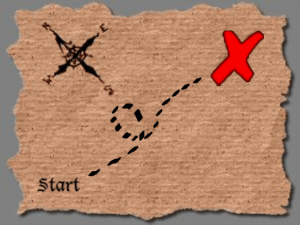
what we want from our leaders. Perhaps we expect too much of them. Should they have all the answers? Should they be all-seeing and all-hearing? Is it reasonable to expect them to set strategy, direction, plan, implement, review, report and make key decisions, as well as dispense wisdom to all who seek it?   Of course not.  But, despite recognising this as impractical, and even unhealthy, as a society we are still encouraged to demand unequivocal and unwavering surety from our leaders.

Pirate_map

At this time, perhaps more than at any time in the past, we need a different set of skills from our leaders. We live in a VUCA (volatility, uncertainty, complexity and ambiguity) world where knowledge is distributed more widely than ever, where more information is instantly available than at any time in history, yet despite all that information, decision-making has never been more difficult. Those who come out of the charismatic ‘all-knowing’ school of leadership present us with dangers. Continue reading

Get Personality Out Of Your Way

“Real knowledge is to know the extent of one’s ignorance” ~ Confucius

Fundamentally, one of the main aims of coaching is to assist people to have a greater understanding of their self, to live a life that is congruent with their values, and ideally one that is both purposeful and fulfilling. Not much to ask, right?

One problem that lies in the way of fulfilling this quest is a little thing called ‘Personality’.  Prof. Tomas Chamorro-Premuzic went so far as to say that “Coaching tries to inhibit the effects of personality on behaviour” (ref: ICF Advance 2015: Science of Coaching Conference).

What is it about personality that causes him to make that assertion? In many ways it sounds counter-intuitive. After all, surely the full discovery and expression of our personalities is something that we seek? The world is, after all, full of people trying to find themselves. According to Prof. Chamorro-Premuzic, the science tells us something different. It would appear that our personality operates in a number of ways, many of which make it tough for us to change our ‘typical’ ways of behaving.

Let’s look at some of the things he highlights about personality:- Continue reading

Acceptance and Commitment

As a coach, I have never been one to feel wedded to a particular philosophy or specific model. There are too many rich and interesting ways of thinking out there, and to ignore them because they don’t fit with ‘your model’ seems short-sighted. Also, no two clients are ever the same, and what works best for one person may not hit the mark for another. As such, I believe that having a deep tool-bag of coaching techniques is essential. That way, and with experience of using them, you can start to get a sense of what will work best for different clients.

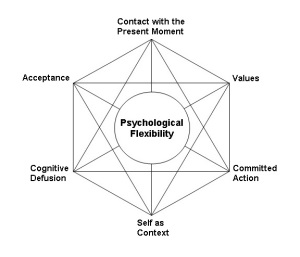
One area that I have recently borrowed from, and found hugely powerful in coaching practice, is that of ACT (Acceptance and Commitment Therapy). ACT is based upon a model of psychological flexibility (called the ACT hexaflex).  The principle being that healthy emotional functioning is achieved as a result of finding a healthy balance of six key processes:hexaflex

  • Acceptance
  • Cognitive Defusion
  • Present Moment Awareness
  • Self Awareness
  • Values
  • Committed Action

ACT also recognises that the unique nature of human language, while clearly setting us apart from all other life on earth in our ability to plan, predict, evaluate and reason, also traps us inside a cage of emotional suffering.  The way we describe ourselves, the world, and how we interact with the world reveals much about our psychological flexibility.  Continue reading

Who Do You Think You Are?

“Dad! Dad! Can I be an astronaut?”

“Don’t be stupid son. You come from Doncaster.” ~ Steve McDermott


Last month I published a post in the wake of the killings in Paris called Hands up if you’re scared. The thrust of the piece was about fear, and the natural (and adaptive) reactions we have to dangerous situations. It was also about the exploitation of that fear, by both terrorists and political hawks.

In addition to those external voices of doom, we also have to be on our guard against our own internal enemy. The voice from within plays into the hands of the arguments of external fear-mongers. Many people have studied and written about the many forms our internal voice takes. Sometimes we can think of it as our conscience, our guide, our fairy godmother, looking out for us and keeping us on the straight and narrow. Or it may manifest in more malevolent form, talking down your talent or competence, criticizing your ideas or dreams, mocking your attempts to break free from “who you are”.

Over many years of working with people as they seek to overcome internal obstacles, I have heard people describe their ‘inner critic’ or ‘gremlin’ in many different ways, but whatever form they take, they tend always to say the same sorts of things to us.

  • “What makes you think you can do that?”
  • “You’ll fail and look stupid.”
  • “You’ll never amount to anything.”
  • “Who’s going to listen to you?”
  • “Who do you think you are?”

Screenshot 2015-12-11 13.26.33I recommend watching this interview between Oprah Winfrey and Brene Brown. The whole interview is fascinating, but if you only have a few minutes to spare, Continue reading