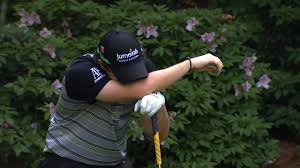
In the week of the 2015 US Masters golf championship, many eyes are on Rory McIlroy. In 2011, an even younger McIlroy was on the verge of making golfing history. He carried a 4-shot lead into the final round, having played sublime golf for the first three days of the championship. However, on his final round he shot the worst round in history by any professional golfer leading after the 3rd round of the Masters. Not the piece of history he was after. Rory suffered what can only be described as a ‘meltdown’ in the unforgiving glare of the TV cameras and the golfing world.
Some pundits questioned his bottle, his psyche, his temperament, and his ‘big game’ mentality. Some said, “history shows that players who cough up big leads in big tournaments often don’t get another chance, their psyches permanently shattered by thoughts of what might have been.” (TwinCities.com)
But, McIlroy went on to win 4 majors in the next three years, starting with the U.S.Open championship, just a few short months after his Augusta meltdown. He achieved his victory in some style too, setting a new championship record and becoming the youngest winner since 1923. Continue reading →
“Humble Inquiry is the skill & art of drawing someone out, of asking questions to which you do not already know the answer, of building a relationship based on curiosity & interest in the other person.” ~ Edgar H. Schein
Doing and telling are valued more in western, industrialised societies than asking and relationship building. We hire and promote people who can get the job done. Asking for help and admitting that you don’t know are considered taboos to striving and ambitious people.
However, one quality of great leaders that comes out consistently close to the top in studies of leadership is the ability to master ‘humble inquiry’. Leaders who ask questions, who do not pretend to know answers, and who recognise that their people are the real experts, inevitably command greater respect and are considered to be more effective leaders.
And why should this be so? Well, consider the charismatic, know-it-all boss who operates by telling. They may command a type of respect, possibly grounded in fear or concerns of inadequacy. But, will people be prepared to approach them with problems, issues or concerns? If relationships have not been established that make it easy for people to share problems, there is a danger that critical information could be withheld, even safety critical or life-and-death information may be held back.
Few would argue with the notion that self-awareness is a vital prerequisite for any effective leader. It is, after all, a key building block for emotional intelligence (EQ), providing the foundation for greater self-regulation, which in turn lends itself to more astute social awareness and finely tuned social skills, including leadership.
Be careful of false promises however. Many books and articles have been written promising great things on the back of EQ mastery. Unfortunately, many of these words of wisdom miss the point. EQ is not just a set of skills to be learned and used, as simply as switching on a light. True EQ embodies a mind-set and a ‘way of being’ that is imbued with honourable intentions.
It is fashionable, indeed expected, for leaders to be in tune with their emotions, to understand themselves deeply, and to be equipped with the skills to know and read others’ emotions and motivations. There is a danger in this, however. A danger that lies at the very heart of how we expect our leaders to be.
Leaders are expected to know stuff. To know the strategy, to provide the direction, to comfort people during periods of uncertainty, to motivate, and have answers to difficult questions about expected future changes in the market. In short, the buck stops with the leader. It’s what they are paid top dollar for, isn’t it?
And how do leaders typically respond to these expectations? By playing the same elaborate game of course. By giving people what they expect. They put on a brave face (“for the sake of morale!”) even when they are unsure. They feel pressure to come up with answers when put on the spot for fear of looking out of their depth (“you never know – you might eventually be ‘found out’ as being a fraud or over-promoted!”). All the while, they stay outwardly calm, self-assured and in control. In other words, they put all of their hard-learned EQ skills into practice. The veneer of self-assuredness, and being completely in tune with people’s fears and uncertainties, proves the value of the hours spent on the books and courses to master these essential ‘people’ skills. But, wait a minute! Didn’t I suggest that this was all a game?
The truth is that this is playing EQ by numbers and not from the heart. The best leaders trust themselves – warts and all – to operate from a place of openness and honesty. This means displaying vulnerability. Yes, even at the risk of scaring the workforce, by having them know you don’t have all the answers. Leaders who can share insecurities, hand responsibility back to others, ask questions rather than provide answers, and use EQ to learn rather than persuade and manipulate, will earn greater respect and trust in the longer term.
People will sense very quickly if your words and actions have a ‘hollow’, transactional and manipulative tone, even if they are dressed up with the EQ language you have learned. Furthermore, you will be modelling the type of behaviour that will become part of the organisation’s culture and be repeated at every level. After all, being a leader is not about you. It is about the people being led. Are you helping to enhance their capacity and creativity? Are you empowering them to have ideas and to influence strategy? Are they growing and developing as people under your leadership?
Self-awareness is the gateway to great leadership, a prerequisite but not, in itself, sufficient. It is not enough that leaders use emotional intelligence; it is vital that they live it.
***********************************************
About the author: Louis Collins enables people to operate more successfully. You may be struggling to implement corporate strategy, you may want to get more productivity out of yourself or your teams but don’t know where to start, or you may not be having as effective conversations as you could be. I will work with you to enable you to formulate more effective ways of leading, to raise awareness of blockers to successful ways of working, and ultimately to help you and your managers to lead more successfully.
Could your organisation benefit from raising the leadership skills of its people? Would you, or members of your management team, benefit from exploring ways to make significant improvements in personal and/or collective effectiveness and productivity? Coaching around the rich field of leadership will help provide the edge that you are seeking in 2015. Coaching has been proven to directly impact the bottom line. Simply drop me your contact details on the Contact Us page and I will be delighted to speak with you.
“…Fear is what keeps us from going over the edge……I don’t think what makes a good race car driver is a fearless person. I think it’s somebody that is comfortable being behind the wheel of something that’s somewhat out of control”. ~ Jeff Gordon
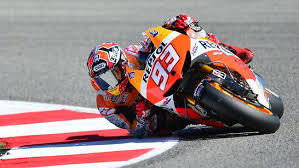
Imagine yourself riding a motorcycle in a high-speed race. You are at full throttle going round the final bend. Only a delicate balance between gravity and centrifugal forces are preventing you from flying off the track. At that moment, are you in control of your bike, or are you out of control? The answer is you are ‘right on the edge’. Too much ‘in control’ and you probably aren’t taking enough risk, and are unlikely to win the race. Too much ‘out of control’ and the likelihood is you are in for a very painful crash.
In 2013, at age 20, Marc Márquez of Spain became the youngest ever World Champion of MotoGP in the final race of the season in Valencia. For anyone who hasn’t witnessed MotoGP, it is truly breath-taking. Riders appear to defy gravity on the bends, with their knees and elbows scraping the surface of the track at speeds in excess of 300km/hour. Experts have commented on the young Márquez’s style saying, “….he drags his elbow on every corner and leans his body and bike closer to the ground than any of his rivals.” In this sport, being daring and aggressive is a requirement if you hope to succeed. It would look as though an ability to shut out thoughts of fear, and consequences of getting it wrong, are a necessity in this sport. Yet, at the same time, knowing, in that instant, just what would be too much, too fast, too risky is clearly also a vital (and life-preserving) requirement. As is resilience, perseverance and the ability to learn from (and not be put off by) misjudgements.
During the course of the season, Marquez also set the record for the highest-speed crash in motorcycle racing. While practising his gravity-defying turns, he lost control at 320km/hour. He managed to throw himself from his bike just before it crashed against a concrete wall. He was catapulted into a gravel safety trap at 280km/hour, walked away, and competed in the race the next day. He is very clear about the fact that he must keep learning and improving. In the final race of the season, he needed to finish no worse than fourth to secure the title. He worked out that keeping his two main rivals in front of him, where he could watch their every move, was a better strategy than having them plot and scheme their moves from behind him. He rode a sensible, calculating race, taking less risks, staying out of trouble, and safely securing third place, sufficient to win the World Championship. Continue reading →
The leadership mindset that led us into the global economic downturn is not fit for the purpose of leading us back out again.
Recessions encourage cautious mindsets, resulting in refrains such as, “Batten down the hatches, let the storm blow over, it’s not a time for taking risks, let’s just make sure we are still standing at the end of this – we’ll be in good shape to start again.” And, “Sorry, there’s no budget for people development. Not the right time to explore new means of production. Not possible to invest in innovation initiatives.” These leadership mantras have become engrained in the psyche of many a business culture during the last five or six years.
Leadership mindsets have themselves become victims of the downturn. The focus on cost reduction and the bottom line has stunted many leaders’ abilities. The question is, how easily will they be able to shift into a frame of mind that embraces growth, change and innovation. Some who once had visions of new and exciting futures have resorted to being excited by ‘making budget’.
“I believe this passionately: that we don’t grow into creativity, we grow out of it. Or rather, we get educated out if it.” ~ Ken Robinson
We live in a world that favours conformity over diversity, despite the fact that no two people are the same. I guess we do this because it seems easier. How could we build a health system, prison system or education system individually tailored to the needs of each and every person who passes through it? That would be impossible wouldn’t it? Well, yes, at the overall organization and administration level that is undoubtedly true, but what about at the point of delivery? Is it really impossible to see each recipient of education, health care or custodial reform as individuals, with different needs and unique histories?
Enjoy this immensely funny, but deadly serious, talk by Sir Ken Robinson, as he warns against the dangers of an education system that favours compliance over individuality, standardisation over creativity.
We need curiosity for learning and for human growth. Intelligence is not simply measured by how many facts you know, but about asking great questions, being endlessly curious and making, breaking and re-creating neural connections, constantly, even into old age. A great education system will provoke, stimulate, challenge and harness people’s innate curiosity.
Creativity is being stifled in far too many of our education regimes around the world. It is, after all, what drives human evolution and cultural development. It is what has made our society what it is today. We are the beneficiaries of our audacious and creative ancestors who dared to dream big, gifting us our transport systems, our medicines, our computers and communication networks, our architecture and our libraries of information. Who will deliver the next generation of dreams?
Unfortunately, and too often, our systems drive cultures of compliance, which ignore the value of the individual in favour of the ‘hollow success’ of the system. Hollow, because no system can be deemed successful, unless the people it is intended to serve are thriving and benefiting from how it is being run. We treat education like an industrial process which can be tweaked and tuned till it is operating like a well-oiled machine. But education is a about humans, individual people, and not about the system.
It does not have to be this way. The countries of northern Europe have been daring to do things differently for some time. Robinson, in his talk, points out that Finland has no standardisation in its schools. They individualise learning, attribute high status to the teaching profession and have no pupil drop-out rate. The Finns are regarded as having one of, if not, the best education system in the world, yet their pupils do not start school until the age of 7, and are not obsessed with exams and standards. Pupils do not sit any formal exams until the age of 16. And it is not only in education that they lead the way. Finland and Sweden can measure the number of under-18s that it hands out custodial sentences to each year on the fingers of one hand. They prefer to deal with young offenders individually by providing treatment, rehabilitation and support, rather than throwing them into the criminal justice system, where they become a statistic and are much more likely to re-offend after release.
Like the rare flowering seen in Death Valley after occasional rainfall, dormant talent can
be reinvigorated. We just need to create the right climate and conditions, and focus on nurturing individual creativity and curiosity. Leaders in education, and in all of our major institutions responsible for harnessing young people’s talent, need to practise less command and control and more climate control.
***********************************************
About the author: Louis Collins enables people to operate more successfully. You may be struggling to implement corporate strategy, you may want to get more productivity out of yourself or your teams but don’t know where to start, or you may not be having as effective conversations as you could be. I will work with you to enable you to formulate more effective ways of leading, to raise awareness of blockers to successful ways of working, and ultimately to help you and your managers to lead more successfully.
Could your organisation benefit from raising the leadership skills of its people? Would you, or members of your management team, benefit from exploring ways to make significant improvements in personal and/or collective effectiveness and productivity? Coaching around the rich field of leadership will help provide the edge that you are seeking in 2015. Coaching has been proven to directly impact the bottom line. Simply drop me your contact details on the Contact Us page and I will be delighted to have an initial discussion.
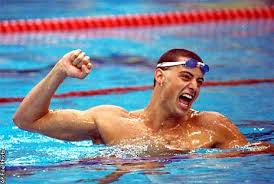
A great deal of pressure was heaped on the young shoulders of Matt Biondi in the run up to the Seoul Olympics in 1988. He was one of the United States great hopes for multiple medals in the swimming pool. Comparisons were being drawn with the legendary Mark Spitz who had won seven golds in the 1972 games. In his first event, the two-hundred-metre freestyle, he finished a creditable third. Great by most people’s standards, but disappointing for Biondi and the hard-to-please media back home. The next event was the one-hundred-metre butterfly. Having blasted into an early lead, and dominated the race all the way, he made an error of judgement on his final stroke. One more stroke squeezed in with a metre to go would have seen him home, but he chose to coast and stretch for the wall instead. In doing so he was pipped by a fingernail and beaten into second by an unknown swimmer, Anthony Nesty, from Surinam, not a country renowned for swimmers, let alone gold medals.
There was much gnashing of teeth and criticism levelled at Biondi from afar. This was not the start to an assault on seven gold medals that the American public expected, and many started to write him off. There was at least one person who did not, however. Marty Seligman, the father of Positive Psychology, watching proceedings on his television, had belief, and evidence, that Biondi had what it would take to come back from these disappointments and go on to achieve success. Continue reading →
When we are no longer able to change a situation, we are challenged to change ourselves. ~ Viktor E. Frankl
All learning happens at ‘the edge’. Going to the edge, and looking beyond, creates uncertainty. After all, when nothing is changing and your world is predictable, what is the need to change, or learn anything new? Sometimes changes are forced on us, sometimes they are sought. Either way, they induce learning and growth.
This appears to be at the very heart of our existence as a species. Skulls found in the Great Rift Valley of East Africa, the cradle of humanity, point to increases in skull capacity, and by definition brain size, at specific points in the earth’s history that correspond to periods of dramatic environmental change.
Professor Brian Cox’s recent BBC programme, Apeman to Spaceman, explains that the earth experiences major and rapid climatic changes approximately every 400,000 years. The skulls of various generations of hominin species (i.e. from australopithecus, to homo erectus, through to early homo sapien) reveal an almost doubling of brain capacity every 400,000 years. The theory he advances is that human intelligence is quite literally a response to periods of rapid changes in the environment as a result of violent climate fluctuations.
And while this theory is concerned with enormous changes over thousands of years, the conditions for changes driving growth and learning are no less evident within single lifetimes. Continue reading →
“May your choices reflect your hopes, not your fears.” ~ Nelson Mandela
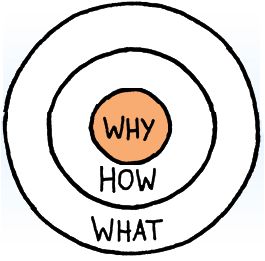
The current Scottish Independence campaign has highlighted many questions and parallels with the world of leadership and inspiration. Reading this post about the importance of Getting Back to Why, I was reminded of Simon Sinek’s Golden Circle. People are inspired by “Why” and not by “What” or “How”. To gain a greater understanding of how the golden circle model works, this TED talk is well worth watching.
The independence campaign has almost exclusively been conducted on the question of How. “How will Scotland run its economy?” “How will it balance its books?” “How will it ensure its security?” How…! How…! How…! Questions that do not inspire, that do not contribute answers, and which, in the main, generate doubt, uncertainty and fear. It is little surprise, therefore, that a predominantly pro-union press and media have allowed the how question to dominate the campaign.
Simon Sinek has shown that the great companies, organisations, politicians and leaders inspire, generate energy and instil hope with “why”. Martin Luther King did not start his speeches by telling people how everything would work in a world after civil-rights was achieved, he started by telling people about his Dreams. Inspiration and hope comes not from having all the details known beforehand, but by being clear on the bigger vision, the grand purpose. No major change in history has ever been made where people have known clearly what lay ahead beforehand. They rarely know how things will work out, but they have known why they wanted to make the change. When purpose and vision is clear, then anything becomes possible. Being clear on the how is of less significance. Those details will emerge, they will evolve, driven by the energies of an inspired and optimistic people who know clearly why they want change to happen.
Back in January I wrote about how it seemed to me that the question Why? is so much more fundamental to the independence referendum than the question How? Yet the mainstream of the debate has been framed almost entirely by How.
The reason’s not hard to see. It’s simpler to place practical obstacles – in this case mainly economic and political – in someone’s path than to convince them of the moral, philosophical or emotional benefits of the status quo. Yet whichever way you plan to vote you must surely be clear about why you do or don’t want independence before you start to consider how it might or might not come about.
I was reminded of that post this week by a friend at the Edinburgh International Book Festival. It made me think that I myself have been too easily caught up in the How? of late, and that…
What do you do if you can no longer live with the doubt…? You try to cure yourself. And the best cure for doubt is over-conviction. ~ Richard Holloway (2013)
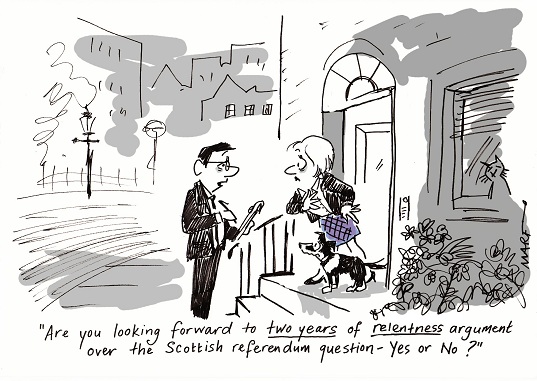
As a Scot, I have been intrigued by the developing rhetoric of the politicians on either side of the upcoming referendum question. They hone their arguments in an attempt to win over voters to one or other side of the debate. Should Scotland be an independent country? Simple enough question, but it sits atop a mountain of uncertainty, doubt and fear.
source: with thanks to Marf (Martha Richler)
Many people have already made up their minds, and nothing the politicians do during the campaign will sway them from their conviction. They are people who are clear on the question, they are certain what the answer is, and they are in no doubt. But, ultimately, the people who will determine the outcome, are the currently undecided people of Scotland. They remain uncertain, they have doubts, they have no clear conviction.
And what is it that people want to hear from their politicians and leaders when they are unsure? What engages people who are having doubts and uncertainties about the future? Personally, I want to hear leaders tell me that they understand my concerns, that they too have those feelings of uncertainty, that doubt and fear have entered their head too. I am unlikely to respond or relate to yet another ‘conviction’ speech. The sort of argument that suggests that there is no room for doubt. And, yet, what I am hearing, from both sides of the referendum campaign, are entrenched arguments, conviction statements, and a total absence of humility.