
From Conflict to Collaboration

Inter-personal or group conflict is an inevitable consequence of people working together in teams.  In fact, conflict can be a good thing, as it is a sign that people care and are passionate, and, if those energies are channelled correctly, they can be a great source of diverse ideas and solutions.

Too often however, conflict results in negative and damaging outcomes. It can hurt morale, suppress individual effectiveness, and, ultimately, destroy team productivity. Left untreated, it results in a downward spiral of negativity, emotions and blame.

A helpful starting point is to understand some of the theory, and to recognise that people have different (and preferred) styles of dealing with conflict.  There is no one style that will work best in every situation, but once you have an understanding of the different styles, you have the opportunity to step back and think about the most appropriate approach (or perhaps mix of approaches) that will suit the current situation. And, having a raised awareness of your own ‘natural’ style is a good first step to helping you learn and adapt when necessary, so that it does not remain your only style.  (For a deeper treatment of this area, see the work of Ralph H. Kilmann and Kenneth W. Thomas)

The list of styles identified through their work are:
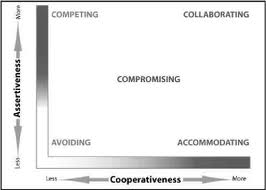
  • Avoiding – Acting in a  way that does not address the conflict directly. This style is typified by delegating controversial decisions, accepting default decisions, and not wanting to hurt anyone’s feelings. It can be a viable style to adopt when the issue and the relationship are of very low importance, but it should be used with extreme caution.  Avoiding a serious issue may make the conflict intensify, possibly damaging relationships further.
  • Accommodating – Involves accepting the other party’s position or interest at the expense of your own.  People who naturally adopt this style are not assertive but highly cooperative. It may be appropriate when the issue matters more to the other party and when peace is more valuable than winning. It can, however, be counter-productive as you may be seen as weak, especially if used repeatedly. Furthermore, constant ‘accommodating’ may lead to increased stress.
  • Competing – Working to have your position or interests take priority over those of the other party.  People who tend towards a competitive style take a firm stand, and know what they want, usually operating from a position of power (whether position, rank, expertise, or persuasive ability). It can be useful in an emergency when a decision needs to be made fast; or when defending against someone who is trying to exploit the situation selfishly. However it can leave people feeling bruised, unsatisfied and resentful when used in less urgent situations.  It is also not a useful style when it is important to generate diverse ideas or multiple solutions.
  • Compromising – Involves each party giving and getting a little in terms of position and interests.  People adopting a compromising style seek solutions that will to some extent  satisfy everyone. This approach depends on everyone being prepared to give up something. It can be useful when the cost of conflict is higher than the cost of losing ground, when equal strength opponents are at a standstill and when there is a deadline looming. It is unlikely to work successfully for issues of principle and may cut off opportunities for collaborative problem solving.
  • Collaborating – Parties attempt to meet all or most of the interests underlying their respective positions.  Collaborators can be highly assertive, but unlike the competitor, they cooperate effectively and acknowledge that everyone’s input is important. This is the most useful style when it is important to bring together a variety of viewpoints to get the best solution; when there have been previous conflicts in the group; or when the situation is too critical  for a simple trade-off.  It is most effective for generating ‘high-quality solutions’ but requires a very high level of trust between parties, and relies on the use of  considerable interpersonal skills (e.g. it is vital  to confront issues directly without threatening the other party). For some situations it may not be appropriate due to the fact that it can take considerable time and effort to implement.

‘True’ Collaboration is an often misunderstood and overused term.  It has been fashionable for companies to Continue reading

What gets in your way and blows the conversation?

Because we are human we have a number of fairly predictable reactions and behaviours in given situations.

All people, regardless of culture, gender, experience, job or position in the hierarchy, operate according to the same set of principles when under even fairly mild levels of stress. [For a more detailed treatment of this area I refer you to Chris Argyris’ work on double-loop learning ] 

  1.  We seek to maximise comfort and minimise negative emotions that means both our own and also the other person with whom we may be interacting at the time. 
  2. We will, at the same time as aiming to maintain a position of comfort, still aim to maximise our chances of winning and avoid losingin other words, we typically want to get our point across, and let others see where the problem lies or solution should come from
  3. And third, we seek to maintain controlwe typically try to put out a feeling of rationality and self-control (even when it is lacking) and aim to maintain control of where the discussion or outcome is going so that we can ‘steer’ others to the outcome we want

All of this adds up to a heady mix of potential problems in our everyday dealings with people – especially when stakes are raised, when emotions rise and when threats start to emerge.  The ways in which these principles and values emerge in our behaviour can differ from person to person – sometimes overtly and sometimes beneath a veneer of control, respectability and respect.  The underlying purpose of these strategies is to avoid vulnerability, avoid risk, and avoid appearing incompetent.

But, before you go away with an overly pessimistic view of the human race, don’t worry. First of all, this is natural, and is, to a large extent, a strategy that has helped us survive as a species through our evolution.  These strategies were necessary in the primeval world our ancestors navigated, but they are deeply defensive strategies, and rooted in a desire for self-preservation.  When they show up in our everyday lives, in meetings, in performance reviews and in relationships, they undermine our effectiveness and get in the way of building productive relationships, they are “anti-learning”, and damage the chances of constructive outcomes.

The good news is that we know about these de-railers and how and when they show up, and we can do something about it.

Fundamentally the approach to overcoming these is simple….. Continue reading

Stretch Goals dull our thinking

I was prompted to write this post after reading Daniel Markovitz’s recent article in HBR in which he makes a really good case for challenging the value of Stretch Goals.  To summarize he makes 3 key statements:

  • Stretch goals can be terribly demotivating.
  • Stretch goals have a dangerous tendency to foster unethical behavior.
  • Stretch goals can also — tragically — lead to excessive risk taking.

The way in which goals, targets and objectives are applied in many of our companies and organisations is now open to question and review. The principles and methods by which they are applied has changed little from the industrial days of their birth.

Within a factory-based model of production, when tasks were well-defined and output easily measured, targets, and especially stretch targets, were useful ways to drive up productivity.  After all, if you wanted to increase widget production by 10%, you worked  people harder, increased the speed of the conveyor, offered bonus targets (or overtime payment), and measured the success of your intervention immediately and directly.

However, most problems and challenges we face today are not of this order. Companies, organisations and governments are looking for creative, innovative solutions to intangible and intellectual problems. We don’t even know the right question in many cases yet, let alone reward people for achieving stretch goals that produce answers that may not even be correct or appropriate. Despite this, we appear reluctant to break away from the traditional factory model of reward and motivation.

The evidence, however, is clear.  Stretch goals and offering people bigger rewards to solve intellectual problems actually has the effect of lowering performance. It is in fact a disincentive.  They work in the case of clear, well-defined and narrowly focused tasks, but with complex, intellectual problems they actually dull thinking and cause people to have too narrow a focus.

This is addressed excellently by Dan Pink in a TED talk on “the surprising science of motivation”. If you haven’t watched this, I thoroughly recommend it to you.

The entire concept is flawed.  The incentives system is allegedly “designed to sharpen thinking and accelerate creativity, and it does just the opposite. It dulls thinking and blocks creativity.” (Dan Pink)

But, let’s be clear. I am not saying that Continue reading

Are you prepared to upset the Apple Cart?

I recently had a conversation with a senior manager in a large global organisation about how he was applying performance management in his area.  What he told me surprised me.  He had a few people in his teams that were clearly not performing as well as they could.  Their contributions, when set against people doing similar jobs in other parts of the business, were lower, and they showed no desire to grow and develop beyond their area of specialism. But the manager appreciated their efforts, saw them as ‘steady-eddies’ and knew they would never be star performers.  They were valuable to him, because they had skills he would find hard to replace, even though he knew demand for those skills were in rapid decline. He saw no point in ‘upsetting the apple cart’, as he put it, as everything was running quite smoothly.  His customer was happy, his team was happy, and he was happy. So, why cause problems?

I asked him how he wanted to be viewed by his team as a leader, when they looked back on their careers.

At first he thought that they would see him as a ‘friendly manager’, someone they could ‘trust’, who ‘looked after them’, and to some extent ‘protected them’ from all of the ‘latest fads’ and ‘initiatives’ that were doing the rounds in the business.  Those ‘fads and initiatives’ that he was referring to are about preparing people for what are major global changes within the industry, that are demanding different skills and ways of working.  People are being encouraged to take responsibility for their own careers, to uplift their skills, and develop new ways of thinking to better prepare themselves for the disruption and challenges that are rapidly emerging.

I suggested that it was possible they would look upon him as a useful buffer and protector from ‘disruptive change’ in the short term (or for as long as their area remains viable), but that in the longer term they are likely to look back and question why others had ‘stolen a march’ on them.

They may be saying things like: Continue reading

We get the Leaders we deserve?

If we accept that successful leadership helps people to take responsibility, to grow and develop, and to make hard choices, then, by definition, when people remain reliant and dependent on others providing answers, guidance and direction, and are content to let others do the work, then the leadership we get is, at best, sub-optimal.

People like to elect or hire leaders to provide them with the right answers, and not to confront them with challenging questions or difficult choices.  But, the great leaders do just that. They do not resort to using their authority to ‘implement their own answers’.  They may set out the vision, they may indicate the general direction we need to follow, but they will also put responsibility back in the hands of people to come up with the answers that are right for them and to be implemented at a pace that is tolerable.

Indeed, the more challenging the problem and the more risks involved, the more that people need to face up to the adaptive pressures and the choices that they face.  And, paradoxically, it is under these extreme situations that leaders come under the most pressure to provide the right answers.

The danger in these situations is that some leaders will Continue reading

Commitment v Compliance. What’s the difference?

All good leaders know the difference between ‘internal commitment’ and ‘compliance’. Yes, sometimes, compliance will have to do, particularly in moments of crisis and great urgency, when there is no time to put the ‘effort’ into gaining real buy-in.

But, the downsides of trying to lead when all you have behind you is ‘compliance’ are clear:-

  • People who are not fully committed to your vision and journey are unlikely to ‘go the extra mile’ when the going gets tough.
  • People will need convincing over and over again as each new situation arises.  Basically you buy compliance with a ‘for one use only’ sticker. 
  • People do not undergo learning and growth so successfully when they adopt a state of ‘grudging compliance’ , unlike when they are ‘fully committed’ and bought in to what they are doing.
  • People who are not ‘fully committed’ tend to look to others to take responsibility and blame others when things go wrong. In other words they deflect responsibility.

For a leader to be successful in their venture, they need their teams and followers to be fully committed and bought in completely to the vision and journey, and be Continue reading

How do you Influence People?

How often have you thought about your own personal influencing style?  And, has it changed over the course of time?  If it has changed, has that been as a result of your own careful thought-out intervention and change, or has it happened subconsciously, so that you are only aware of the change as a result of reflection?  I suspect that, like most of us, you have not often given it too much thought, especially when in the thick of the action, when deadlines are looming, and decisions just have to be made.

Influencing others is at the very core of Leadership. While that has always been the case, in today’s complex, inter-connected world, it is even more true. To be successful in a world where a leader had direct control over their troops, in an environment where command-and-control was all that was needed, where the tasks expected of people were simply expressed (basically “do-it”, or the slightly more persuasive JFDI), influence was probably less important than straightforward authoritarian directorship.

Effective leaders in today’s business world, recognise that Continue reading

Wrong thing well or right thing poorly. Which do you prefer?

People at the top (however you define that) are more in need of support, coaching, or even just “an ear” than most, and yet they are the least likely to get it. High achievers are afraid to show any limitations. Asking for help – whatever that form takes – is to admit weakness, and our culture does not take kindly to ‘weak leaders’ who need help.

So, how do we want our leaders to be?  What is our model of the perfect leader?

If we don’t expect them to need help, then I fear we are expecting too much of them, and, at the same time, we are creating a ‘vicious cycle’ from which we won’t escape.

The norms and mores of our society have created unrealistic expectations, and as a result we see smart, ambitious people who are less productive and satisfied than they should or could be. Anxiety about performance compromises progress, resulting in lower levels of risk-taking and plateauing careers.

It is not unusual to see high potential achievers avoiding  Continue reading

You Cannot Lead without Inquiry

BLOG UPDATE:  This article was originally posted in February 2012, and I am delighted to see that Hamza Kashgari, the young Saudi writer who inspired the article, has eventually been released from his prison sentence in Saudi Arabia. If you missed the original story, Hamza was imprisoned for expressing views deemed blasphemous by the authorities.  

(see Freedom House article on his release here)

**********************************************************

POSTED Feb 20, 2012      Too many people in positions of authority operate from a position of fear. Fear of not knowing, fear of being found out, fear of looking incompetent, fear of losing what has taken them years to attain.  This is true in companies, public service and politics. People who are in these positions are rarely stupid.  Being smart is usually a big factor in them getting to where they are. But, once they are there, something seems to kick in which is profoundly ‘anti-learning’. To paraphrase the great Chris Argyris, “Smart People find it tough to Learn”.

Today’s story in The Nation of Hamza Kashgari, a 23-year-old journalist, who faces potential death for daring to question, shines a powerful spotlight on the fear with which ‘leaders’ operate. As a species we progress by learning.  We are problem solvers, we are cognitive thinkers, we naturally question, challenge and inquire. It is by doing so that we have overcome the multitude of obstacles that have stood in the way of our evolution over millenia. But, we do not and cannot stand still. To do so would consign the human race to extinction, probably through self-destruction. More than ever before, we require Continue reading

Leadership as an Activity

Ask people to define leaders or leadership and I’m willing to bet they will think of it in terms of people. Figures of authority. Historical figures who have led countries, movements, armies. There is no doubting that the people they mention will have been leaders (good or bad). But it misses the point about leadership. Leadership is not defined by the position or authority one possesses or has been granted. It is better thought of as an ‘activity’. Leadership is evident in the behaviour displayed by people and is measured largely by the extent to which the activity mobilises others to accept responsibility for owning issues, changing conditions and tackling tough challenges. Note, the important point here is about mobilising others. True, leaders can and often do take action and make decisions, but I believe the most significant measure of leadership is the extent to which leaders are able to focus other’s attention on the need to take action. That is the mark of true Leadership. That is what causes real change and alters mindsets, and, very importantly, does not encourage dependence.

I recommend a great read on this topic. Ronald Heifetz who wrote Leadership Without Easy Answers.
If you want to hear a review, have a listen to the attached file which I have recorded. It is less than 15 minutes in duration and will give you more insight to the content of this great book.
Book Review Audio