On the Edge of Control

“…Fear is what keeps us from going over the edge……I don’t think what makes a good race car driver is a fearless person. I think it’s somebody that is comfortable being behind the wheel of something that’s somewhat out of control”.                Jeff Gordon

Imagine yourself riding a motorcycle in a high-speed race. You are at full throttle going round the final bend. Only a delicate balance between gravity and centrifugal forces are preventing you from flying off the track. At that moment, are you in control of your bike, or are you out of control? The answer is you are ‘right on the edge’. Too much ‘in control’ and you probably aren’t taking enough risk, and are unlikely to win the race. Too much ‘out of control’ and the likelihood is you are in for a very painful crash.

In 2013, at age 20, Marc Márquez of Spain became the youngest ever World Champion of MotoGP in the final race of the season in Valencia.  For anyone who hasn’t witnessed MotoGP, it is truly breath-taking. Riders appear to defy gravity on the bends, with their knees and elbows scraping the surface of the track at speeds in excess of 300km/hour. marquezExperts have commented on the young Márquez’s style saying, “….he drags his elbow on every corner and leans his body and bike closer to the ground than any of his rivals.”  In this sport, being daring and aggressive is a requirement if you hope to succeed. It would look as though an ability to shut out thoughts of fear, and consequences of getting it wrong, are a necessity in this sport. Yet, at the same time, knowing, in that instant, just what would be too much, too fast, too risky is clearly also a vital (and life-preserving) requirement. As is resilience, perseverance and the ability to learn from (and not be put off by) misjudgements.
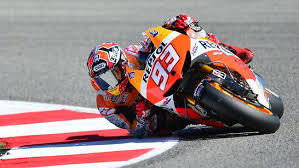
During the course of the season, Marquez also set the record for the highest-speed crash in motorcycle racing. While practising his gravity-defying turns, he lost control at 320km/hour. He managed to throw himself from his bike just before it crashed against a concrete wall. He was catapulted into a gravel safety trap at 280km/hour, walked away, and competed in the race the next day.  He is very clear about the fact that he must keep learning and improving.  In the final race of the season, he needed to finish no worse than fourth to secure the title.  He worked out that keeping his two main rivals in front of him, where he could watch their every move, was a better strategy than having them plot and scheme their moves from behind him. He rode a sensible, calculating race, taking less risks, staying out of trouble, and safely securing third place, sufficient to win the World Championship.
Continue reading
Getting back to Why

“May your choices reflect your hopes, not your fears.” ~ Nelson Mandela

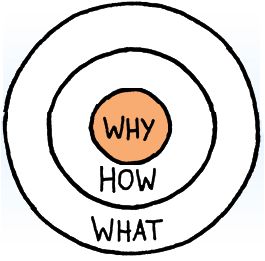
The current Scottish Independence campaign has highlighted many questions and parallels with the world of leadership and inspiration. Reading this post about the importance of Getting Back to Why, I was reminded of Simon Sinek’s Golden Circle. People are inspired by “Why” and not by “What” or “How”. To gain a greater understanding of how the golden circle model works, this TED talk is well worth watching.golden-circle

The independence campaign has almost exclusively been conducted on the question of How. “How will Scotland run its economy?” “How will it balance its books?” “How will it ensure its security?” How…! How…! How…! Questions that do not inspire, that do not contribute answers, and which, in the main, generate doubt, uncertainty and fear. It is little surprise, therefore, that a predominantly pro-union press and media have allowed the how question to dominate the campaign.

Simon Sinek has shown that the great companies, organisations, politicians and leaders inspire, generate energy and instil hope with “why”. Martin Luther King did not start his speeches by telling people how everything would work in a world after civil-rights was achieved, he started by telling people about his Dreams. Inspiration and hope comes not from having all the details known beforehand, but by being clear on the bigger vision, the grand purpose. No major change in history has ever been made where people have known clearly what lay ahead beforehand. They rarely know how things will work out, but they have known why they wanted to make the change. When purpose and vision is clear, then anything becomes possible. Being clear on the how is of less significance. Those details will emerge, they will evolve, driven by the energies of an inspired and optimistic people who know clearly why they want change to happen.

Jamie Jauncey's avatarA Few Kind Words

Back in January I wrote about how it seemed to me that the question Why? is so much more fundamental to the independence referendum than the question How? Yet the mainstream of the debate has been framed almost entirely by How.

The reason’s not hard to see. It’s simpler to place practical obstacles – in this case mainly economic and political – in someone’s path than to convince them of the moral, philosophical or emotional benefits of the status quo. Yet whichever way you plan to vote you must surely be clear about why you do or don’t want independence before you start to consider how it might or might not come about.

I was reminded of that post this week by a friend at the Edinburgh International Book Festival. It made me think that I myself have been too easily caught up in the How? of late, and that…

View original post 944 more words

The Danger of Conviction

What do you do if you can no longer live with the doubt…? You try to cure yourself. And the best cure for doubt is over-conviction. ~ Richard Holloway (2013)

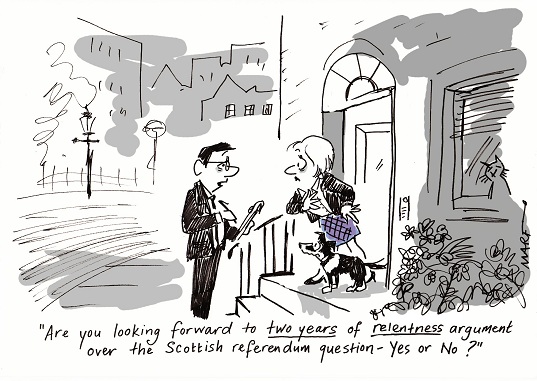
As a Scot, I have been intrigued by the developing rhetoric of the politicians on either side of the upcoming referendum question. They hone their arguments in an attempt to win over voters to one or other side of the debate. Should Scotland be an independent country? Simple enough question, but it sits atop a mountain of uncertainty, doubt and fear.

source: with thanks to Marf (Martha Richler)

source: with thanks to Marf (Martha Richler)

Many people have already made up their minds, and nothing the politicians do during the campaign will sway them from their conviction. They are people who are clear on the question, they are certain what the answer is, and they are in no doubt. But, ultimately, the people who will determine the outcome, are the currently undecided people of Scotland. They remain uncertain, they have doubts, they have no clear conviction.

And what is it that people want to hear from their politicians and leaders when they are unsure? What engages people who are having doubts and uncertainties about the future? Personally, I want to hear leaders tell me that they understand my concerns, that they too have those feelings of uncertainty, that doubt and fear have entered their head too. I am unlikely to respond or relate to yet another ‘conviction’ speech. The sort of argument that suggests that there is no room for doubt. And, yet, what I am hearing, from both sides of the referendum campaign, are entrenched arguments, conviction statements, and a total absence of humility.

Both sides appear to have forgotten Continue reading

Selfless Leadership

Think back to an occasion when you earned yourself a new leadership position, perhaps a hard-earned promotion within an established corporate, or a great new opportunity with an ambitious go-getting young company. Maybe it was your first management role, maybe you had climbed the ladder and it was a C-suite position.

What was your first thought?  (I mean after your well-deserved celebrations had subsided).  When you first sat down and had a moment of quiet reflection on your own, perhaps in your new corner office, what went through your mind?

How many of you actually let your mind drift into the future and a time when you would be leaving this role; the day when your work would be done and time for you to move on? How long would that take, before you could leave the patch in a better state than when you joined, with better equipped people; new leaders who had developed themselves into your space?  How many of you actually set a target date for your own removal as one of your top measures of success?

source: billarends bit.ly/XYDsiG

source: billarends bit.ly/XYDsiG

Continue reading

How do you Influence People?

How often have you thought about your own personal influencing style?  And, has it changed over the course of time?  If it has changed, has that been as a result of your own careful thought-out intervention and change, or has it happened subconsciously, so that you are only aware of the change as a result of reflection?  I suspect that, like most of us, you have not often given it too much thought, especially when in the thick of the action, when deadlines are looming, and decisions just have to be made.

Influencing others is at the very core of Leadership. While that has always been the case, in today’s complex, inter-connected world, it is even more true. To be successful in a world where a leader had direct control over their troops, in an environment where command-and-control was all that was needed, where the tasks expected of people were simply expressed (basically “do-it”, or the slightly more persuasive JFDI), influence was probably less important than straightforward authoritarian directorship.

Effective leaders in today’s business world, recognise that Continue reading