Fail Big, Fail Fast, Fail Often!

In the week of the 2015 US Masters golf championship, many eyes are on Rory McIlroy. In 2011, an even younger McIlroy was on the verge of making golfing history. He carried a 4-shot lead into the final round, having played sublime golf for the first three days of the championship. However, on his final round he shot the worst round in history by any professional golfer leading after the 3rd round of the Masters. Not the piece of history he was after. Rory suffered what can only be described as a ‘meltdown’ in the unforgiving glare of the TV cameras and the golfing world.

Some pundits questioned his bottle, his psyche, his temperament, and his ‘big game’ mentality. Some said, “history shows that players who cough up big leads in big tournaments often don’t get another chance, their psyches permanently shattered by thoughts of what might have been.” (TwinCities.com

But, McIlroy went on to win 4 majors in the next three years, starting with the U.S.Open championship, just a few short months after his Augusta meltdown. He achieved his victory in some style too, setting a new championship record and becoming the youngest winner since 1923.
Continue reading

Self-Awareness: The Gateway to Leadership

This article was originally published in The e.MILE People Development Magazine in Feb 2015.

Few would argue with the notion that self-awareness is a vital prerequisite for any effective leader.  It is, after all, a key building block for emotional intelligence (EQ), providing the foundation for greater self-regulation, which in turn lends itself to more astute social awareness and finely tuned social skills, including leadership.

Be careful of false promises however.  Many books and articles have been written promising great things on the back of EQ mastery.  Unfortunately, many of these words of wisdom miss the point.  EQ is not just a set of skills to be learned and used, as simply as switching on a light. True EQ embodies a mind-set and a ‘way of being’ that is imbued with honourable intentions.Unhappy Girl Looking At Her Reflection On The Mirror

It is fashionable, indeed expected, for leaders to be in tune with their emotions, to understand themselves deeply, and to be equipped with the skills to know and read others’ emotions and motivations.  There is a danger in this, however.  A danger that lies at the very heart of how we expect our leaders to be.

Leaders are expected to know stuff. To know the strategy, to provide the direction, to comfort people during periods of uncertainty, to motivate, and have answers to difficult questions about expected future changes in the market. In short, the buck stops with the leader. It’s what they are paid top dollar for, isn’t it?

And how do leaders typically respond to these expectations?  By playing the same elaborate  game of course.  By giving people what they expect.  They put on a brave face (“for the sake of morale!”) even when they are unsure. They feel pressure to come up with answers when put on the spot for fear of looking out of their depth (“you never know – you might eventually be ‘found out’ as being a fraud or over-promoted!”).  All the while, they stay outwardly calm, self-assured and in control.  In other words, they put all of their hard-learned EQ skills into practice.  The veneer of self-assuredness, and being completely in tune with people’s fears and uncertainties, proves the value of the hours spent on the books and courses to master these essential ‘people’ skills.  But, wait a minute!  Didn’t I suggest that this was all a game?

The truth is that this is playing EQ by numbers and not from the heart.   The best leaders trust themselves – warts and all – to operate from a place of openness and honesty. This means displaying vulnerability. Yes, even at the risk of scaring the workforce, by having them know you don’t have all the answers.  Leaders who can share insecurities, hand responsibility back to others, ask questions rather than provide answers, and use EQ to learn rather than persuade and manipulate, will earn greater respect and trust in the longer term.

People will sense very quickly if your words and actions have a ‘hollow’, transactional and manipulative tone, even if they are dressed up with the EQ language you have learned. Furthermore, you will be modelling the type of behaviour that will become part of the organisation’s culture and be repeated at every level.   After all, being a leader is not about you. It is about the people being led.  Are you helping to enhance their capacity and creativity? Are you empowering them to have ideas and to influence strategy?   Are they growing and developing as people under your leadership?

Self-awareness is the gateway to great leadership, a prerequisite but not, in itself, sufficient.  It is not enough that leaders use emotional intelligence; it is vital that they live it.

***********************************************

About the author: Louis Collins enables people to operate more successfully. You may be struggling to implement corporate strategy, you may want to get more productivity out of yourself or your teams but don’t know where to start, or you may not be having as effective conversations as you could be. I will work with you to enable you to formulate more effective ways of leading, to raise awareness of blockers to successful ways of working, and ultimately to help you and your managers to lead more successfully.

Could your organisation benefit from raising the leadership skills of its people? Would you, or members of your management team, benefit from exploring ways to make significant improvements in personal and/or collective effectiveness and productivity? Coaching around the rich field of leadership will help provide the edge that you are seeking in 2015. Coaching has been proven to directly impact the bottom line. Simply drop me your contact details on the Contact Us page and I will be delighted to speak with you. 

The Danger of Conviction

What do you do if you can no longer live with the doubt…? You try to cure yourself. And the best cure for doubt is over-conviction. ~ Richard Holloway (2013)

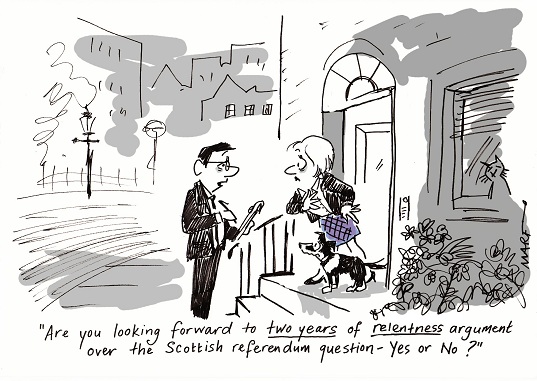
As a Scot, I have been intrigued by the developing rhetoric of the politicians on either side of the upcoming referendum question. They hone their arguments in an attempt to win over voters to one or other side of the debate. Should Scotland be an independent country? Simple enough question, but it sits atop a mountain of uncertainty, doubt and fear.

source: with thanks to Marf (Martha Richler)

source: with thanks to Marf (Martha Richler)

Many people have already made up their minds, and nothing the politicians do during the campaign will sway them from their conviction. They are people who are clear on the question, they are certain what the answer is, and they are in no doubt. But, ultimately, the people who will determine the outcome, are the currently undecided people of Scotland. They remain uncertain, they have doubts, they have no clear conviction.

And what is it that people want to hear from their politicians and leaders when they are unsure? What engages people who are having doubts and uncertainties about the future? Personally, I want to hear leaders tell me that they understand my concerns, that they too have those feelings of uncertainty, that doubt and fear have entered their head too. I am unlikely to respond or relate to yet another ‘conviction’ speech. The sort of argument that suggests that there is no room for doubt. And, yet, what I am hearing, from both sides of the referendum campaign, are entrenched arguments, conviction statements, and a total absence of humility.

Both sides appear to have forgotten Continue reading

Learning from Wimbledon (revisited)

It’s one year since I wrote the post called Learning from Wimbledon.  Andy Murray had just lost an emotionally charged final to Roger Federer. His tearful speech in front of a packed Centre Court and millions more on TV was hard to watch. But, despite the despair and pain that he (and his followers) felt, it was clear that something had changed. His raw talent was clearly good enough to win the major prizes. His tactical awareness was not in question. His physical fitness had been transformed such that no-one in the game worked harder to ensure they were able to go the distance.  The final piece of the jigsaw for Andy was conquering his Inner Game. For years his temperament had been called into question. He cracked at the big moments. The pressure placed on him by the British media and public, hungry for a British Wimbledon men’s champion, was becoming unbearable. If Andy was to succeed, it was going to be a victory inside his own head that would secure the breakthrough.

andy-murray-wins-wimbledon-2013-1373217266-custom-0The Inner Game is played out completely inside the brain. To succeed in the Inner Game one must quieten the ‘voice’ in the head that judges, criticises and worries. It can act in many subtle (and not so subtle) ways, but basically it does one of two things. It either causes us to dwell on and regret past events (e.g. a poorly executed drop shot at the end of the last rally that cost you the game), or it worries about and raises anxiety levels about future events (e.g. if I don’t win my next service game, my opponent will be serving for the match). Neither of these thought processes are useful or conducive to delivering your peak performance. To perform at your best, you need to be operating neither in the past nor in the future, but with total concentration on the present.

Continue reading

Coaching with emotion

We can’t stop ourselves having emotions. Indeed, why would we want to?  So, how do coaches coach from a place that ensures their emotions do not hi-jack their approach and derail the effectiveness of their engagements with clients?  What happens if you feel sorry for a client?  What if you get an overpowering desire to tell someone what they need to do?  What if something they say upsets you, or makes you angry?

Masterful coaches recognise that they can’t (and shouldn’t) block their own emotions, but rather, that they use these emotions to help them be a better coach.  By raising awareness of their own reactions and emotions, coaches can channel their coaching skills into better listening, richer rapport and deeper presence.

source: graciexela.blogspot.co.uk

source: graciexela.blogspot.co.uk

If your emotions leak into your questions, then they will lose impact, and judgements you are making will be transparent. If you are focusing on how you feel, you will not be listening fully to the client, and presence in the moment will suffer. Much better to be open and honest about emotions that are showing up for you. Sharing with a client that, “….this is making me feel uncomfortable right now, how is it making you feel?”, is fine. In fact, role-modelling the sharing of emotions in this way, may well help elicit a deeper exploration and sharing of emotion by the client.

It is when coaching reaches this emotional level that great things often start to happen, and progress and movement becomes possible.

The importance of engaging on an emotional level was discussed in a previous post called the The Upstairs & Downstairs Brain.

**************************

If you feel that you (or members of your team) would benefit from exploring ways to make substantial improvements to personal and collective effectiveness and productivity, please get in touch. Tailored learning programmes are available that have delivered proven benefits, whether your current focus is on:

  • a need to engage your workforce in a positive and compelling way through a transformation
  • how to ensure you get the best out of your investment in talent 
  • ensuring your senior teams, team leaders & middle managers are equipped to handle the conversations that are needed to ensure your organisation is operating as effectively and productively as it could be. 

Simply submit your contact details on the Contact Us page and I will be delighted to get in touch with you for an informal initial chat.