The Power of “Why”

The Power of “Why”: A Child’s Innocence vs. an Adult’s Judgment

Introduction

The word “why” carries a profound weight in the realm of language. When spoken by a child, it evokes a sense of innocence, curiosity, and wonderment. But when uttered by an adult, it can take on a very different meaning, often laden with judgment or even challenge. This contrast between a child’s pure inquiry and an adult’s potentially loaded question is not just about language—it’s about the emotional and social layers we accumulate as we grow. As coaches, we are often taught to avoid using “why” for fear of its negative connotations. But I wonder—are we missing something? Could we harness the innocence and open-mindedness of a child’s “why” to unlock deeper conversations and understanding?


A Child’s “Why”: Innocence, Curiosity, and Genuine Learning

The current image has no alternative text. The file name is: istockphoto-113562048-612x612-1.jpg

I recently watched my granddaughter as she asked the simple question, “Why?” Her eyes were wide with curiosity, her head tilted slightly in wonder. There was no judgment in her tone, no hidden motive behind her inquiry—just a genuine, honest desire to understand the world around her.

For children, “why” is a tool for learning. It’s a gateway to understanding, a way to explore the world without preconceptions. They ask because they want to know more, because they are listening and absorbing new information. The innocence in the way children ask questions is remarkable. It is free of judgment or skepticism. When a child asks, “Why?” it’s a pure invitation to share knowledge.


An Adult’s “Why”: Challenge, Judgment, and Emotional Layers

Contrast this with when an adult uses the word “why.” Suddenly, it feels different. When an adult asks “why,” it can carry an edge of challenge or disagreement. The question may seem like a critique of decisions or opinions, and it often leaves us feeling defensive.

As adults, we have been shaped by our experiences and social contexts. Our language carries with it layers of history, emotions, and assumptions. When we ask “why,” it may not always come from a place of curiosity. Instead, it might be wrapped in judgment, skepticism, or even the desire to question someone’s motivations. This can make the question feel confrontational rather than open.

As a coach, I’ve been encouraged to avoid using “why” because of these emotional connotations. Instead, we are encouraged to ask open-ended questions that don’t feel as loaded. This approach makes sense in many contexts—it creates a safer space for communication, allowing the other person to feel heard without feeling challenged.


Could We Reclaim the Power of “Why”?

But here’s where I start to wonder—are we missing something by avoiding the word “why”? Is it possible to reclaim the innocence and openness that children bring to this question?

What if we could use “why” in a way that mimics the approach of a child—genuine, non-judgmental, and full of curiosity? If we could ask “why” with an open mind, with the intention to learn rather than to challenge, perhaps it could foster deeper, more authentic connections.

By harnessing the child-like innocence of “why,” we could ask the question in a way that encourages open dialogue and invites exploration. Instead of feeling defensive, the person being asked could feel supported in sharing their thoughts and emotions, knowing that the question is coming from a place of understanding rather than judgment.

As coaches, we encourage growth, exploration, and self-awareness. We seek to help others reach their fullest potential. And perhaps by integrating a more childlike approach to asking “why,” we can create an environment where curiosity reigns, and judgment takes a back seat.


Conclusion

The word “why” holds immense power, but its meaning changes depending on the intention behind it. When children use it, it’s a simple, pure tool for learning. When adults use it, it often carries emotional weight and judgment. As coaches and communicators, it’s essential to understand this dynamic—and to consider whether we can reclaim the innocence and openness of a child’s “why” to foster deeper, more compassionate conversations. By doing so, we may just unlock the full potential of this simple, yet powerful question.

If you feel that you or members of your management team could benefit from exploring areas that can make substantial improvements to your personal and collective effectiveness and productivity, please do get in touch. Simply submit your contact details on the Contact Us page and I will be delighted to get in touch with you for an informal initial chat.

Get Vulnerable and Get Curious.

I accept that my perception of what is going on the world is tinted by the lens through which I find myself viewing it.  Brexit, Trump, Knife Crime, The Wall, Gaza. The daily menu for rumination is endless.  But what worries me most are the reactions I see and hear around me; in the street, on the train, in the barbershop, on radio phone-ins, and on social media. People sound angry. Angrier, it feels to me, than just a few short years ago.  Not just a good old-fashioned straightforward type of anger. The anger that wells up in our chest when we observe an injustice only to dissipate soon after.  No, the current anger that is milling around among us is more impatient, more intolerant and much more pervasive.

What’s going on?  We hear the cry around us all the time for greater certainty.  I hear it everywhere.  People demand answers and they want them now. They want decisions and they don’t understand why decisions are not being made, now. They have had enough of politicians, they have dismissed experts, indeed they feel that the whole ‘establishment’ (whatever that actually is) has let them down and they have simply had enough.

This is unfortunate timing, as we are living in an era that is arguably the most volatile, uncertain, ambiguous and complex period in the history of the planet.  The term VUCA has been coined specifically to capture this and has become something of a trendy managerial acronym.  If there was ever a time when we humans need the capacity to live with, and cope with, VUCA conditions, then this is it.

image by Alexey Kljatov // creative commons

But this growing intolerance is not happening simply by chance or because the world has hit a particular high water mark of VUCA. It appears to me to be more sinister than that.  It is being fueled by politicians and governments, ably supported by elements of the media, to generate populism and simplistic thinking.   Arguments are reduced to ‘Yes versus No”. “Us versus Them”. “Right versus Left”. Social media often gets blamed for causing shallow analysis and lack of critical thinking, and I have some sympathy with that view. But, let’s be clear, social media has exaggerated and amplified things, it has not created the problem. When we are engaged in our social bubbles we get fed more of what we already believe. Information comes to us, not as conversations with arguments and rationale, but as  soundbites, as snippets, as shock headlines. We become more and more lazy in the way we consume data. Continue reading

Spark Inside

This blog has been copied from a blog written by Jack Merritt on The Exceptionals, an organisation that helps businesses employ ex-offenders by connecting them with relevant organisations who provide training, recruitment and ongoing support.  

“Sometimes when we talk about prisoners and prison, we forget that we’re talking about people. These are parents, siblings, children.” – Baillie Aaron, Spark Inside Founder and CEO

Spark Inside Founder Baillie Aaron: ‘Why we need to rethink England’s prison system.”

“Spark Inside’s work is vital and unique. It is the global pioneer in offering life coaching to young people in prison, enabling those facing the most significant life obstacles to have more fulfilling, purpose-driven futures. Spark Inside provides that rare antidote in today’s complex criminal justice climate: hope.” – Rt. Hon. David Lammy MP, Member of Parliament for Tottenham

According to Spark Inside, prison doesn’t work, because it isn’t effective in reducing crime. Although 97% of prisoners say they want to leave crime behind, 49% will go on to reoffend within one year. This figure increases to 65% for 15-18 year olds. Spark Inside wants to see people leaving prison break this cycle of reoffending. Founded by Baillie Aaron in 2012, Spark Inside aims to bring about a criminal justice system which prioritises rehabilitation.

How do they plan on doing this? Through two innovative and effective coaching interventions.

Continue reading

You’ve got 8 seconds to get my attention!

“The average attention of a “millenial” is 8 seconds”.

Who said so?  Well, a “millenial” of course!  Not just any “millenial”.  This attention-grabbing claim was made by an impressive young man who was a presenter at a conference I attended this week in London.  Billed as a ‘disruptor’, (credit: Ilias Vartholomaios, Co-Founder of Owiwi) he spoke about the realities that those of us who identify with the 20th Century (I’m one) will have to come to terms with as we live out the remainder of our lives in the 21st.

Young people born after 1995 have not yet become part of the mainstream workforce. He informed us that, by the time they reach the age of 21 they will have spent (on average) 10,000 hours playing online games. As a comparator, that is pretty much the same amount of time an average US student will spend in high school between fifth grade and graduation, assuming a perfect attendance record.

So what?  Continue reading

The Power of Deep Democracy

img006a34e7c (1)

I recently experienced my first Deep Democracy workshop as a participant and it was a real eye-opener.  It is simple yet powerful, and has the potential to create real transformation, not just routine actions for improvement. It was born out of  South Africa’s transformation from apartheid to democracy, and is used by leaders and facilitators from all walks of life. The process enables voices to be heard that are often left unheard, and mines the inherent wisdom hidden within the system by resolving tension and conflict.  (see Deep Democracy).

The process invites people to step into different perspectives or roles, some of which they may not be in agreement with.  The conversations that emerge from these different perspectives are illuminating. New information is surfaced, new possibilities emerge and collective wisdom that has been buried within the system is given an opportunity to reveal itself.

At a time when people all around the world are questioning what is real, what is true and what is fake news, the very meaning of democracy is under challenge. Who runs things? Is it the politicians?  What is the role of the media? And what about the technology giants, such as Facebook, Google and Amazon?  Where do we go to seek our answers and who can we rely on to reveal the truth about what is most important for us?  Continue reading

Is The Appraisal System Dead?

If, as is reported, as many as one third of U.S. companies have abandoned the traditional appraisal system (ref:The Performance Management Revolution), and the signs are that more and more are joining the revolution, what is the future of performance management? How will companies ensure that people do what is expected of them in the future? How will managers know who’s good and who’s not? How will they advise on development, or decide who to sack and replace?

Major players such as Dell, Microsoft and IBM, as well as previous champions of the
forced ranking system such as GE, are at the vanguard of new approaches to retaining and developing talent.  These companies are responding to many issues and criticisms which have been levelled at traditional performance management systems. In some organisations they have become enormous consumers of people’s time. With  the move to
flatter organisational structures and virtual or globally dispersed teams, supervisors have had to contend with larger and larger teams. The answer to this problem in some companies has been to turn the job of performance management over to ‘specialist’ people creativitymanagers, who do little else other than manage the entire cycle, quarter after quarter. Ranking, levelling, forced distributions, identifying rising stars, identifying laggards, assessing delivery against stretch targets, calculating the distribution of the bonus pot, and starting the whole cycle again.  This has become an industry in its own right, and one that delivers no core benefit to the customer or the shareholder.

A number of factors have played a part in driving the shift we are now seeing.  Continue reading

Mining for Treasure

You could be excused for wondering whether leadership has gone out of fashion right now. Whether it be politics, business or sport, wherever you look, there appears to be a vacuum at the top, and much discrediting of those leaders who remain.

What could be going on?  Well, I think one of the problems is that we are mixed up about
what we want from our leaders. Perhaps we expect too much of them. Should they have all the answers? Should they be all-seeing and all-hearing? Is it reasonable to expect them to set strategy, direction, plan, implement, review, report and make key decisions, as well as dispense wisdom to all who seek it?   Of course not.  But, despite recognising this as impractical, and even unhealthy, as a society we are still encouraged to demand unequivocal and unwavering surety from our leaders.

Pirate_map

At this time, perhaps more than at any time in the past, we need a different set of skills from our leaders. We live in a VUCA (volatility, uncertainty, complexity and ambiguity) world where knowledge is distributed more widely than ever, where more information is instantly available than at any time in history, yet despite all that information, decision-making has never been more difficult. Those who come out of the charismatic ‘all-knowing’ school of leadership present us with dangers. Continue reading

Collusion of Confusion

People do not go out of their way to seek data that contradicts their existing beliefs. On the contrary, they will select any data they find that supports existing assumptions. We may like to believe that we are open to having our minds changed, but the reality is that we are quite fixed when it comes to our mental malleability.

Evidence for this assertion is being played out daily on our radios and televisions, as people debate the pros and cons of Brexit. There is an uncanny collective agreement amongst the public that they do not get enough facts to help them arrive at a logical and balanced position. We hear this refrain in panel discussions, question time and vox pops. “How are we supposed to know what the truth is? One lot give us a load of statistics, and then the other lot come along and tell us that is all wrong and hit us with another load of statistics.”

I watched one such programme recently, where a member of the public made exactly this
point. He levelled his accusation at one of the ‘experts’ on the panel. His complaint centred around the costs of running the EU along with an assertion that Britain should not be run by unelected bureaucrats. The expert spent a reasonable amount of time patiently 141201.unbiasedexplaining the facts. He explained that calling all of the EU machine unelected was not accurate.  He pointed out that the EU Parliament, which is made up of elected national representatives, does in fact have a veto over recommendations put forward by the EU Commission. And that the EU Council is also made up of one member from each state in the EU, each of whom will have been elected as part of their home nation’s general elections.  This was all delivered in a tone of neutrality, and with a genuine desire to help alleviate concerns and misunderstandings.  At the end, the person who had raised the original issue was asked if the information provided had helped. His response was not positive. Exasperated, he accused the ‘expert’ of simply adding to the confusion and misconceptions, and “just who was he supposed to believe?”
I suspect the data provided Continue reading

Getting back to Why

“May your choices reflect your hopes, not your fears.” ~ Nelson Mandela

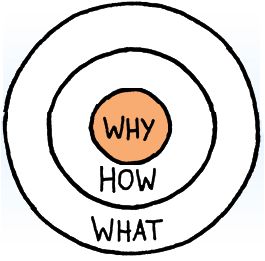
The current Scottish Independence campaign has highlighted many questions and parallels with the world of leadership and inspiration. Reading this post about the importance of Getting Back to Why, I was reminded of Simon Sinek’s Golden Circle. People are inspired by “Why” and not by “What” or “How”. To gain a greater understanding of how the golden circle model works, this TED talk is well worth watching.golden-circle

The independence campaign has almost exclusively been conducted on the question of How. “How will Scotland run its economy?” “How will it balance its books?” “How will it ensure its security?” How…! How…! How…! Questions that do not inspire, that do not contribute answers, and which, in the main, generate doubt, uncertainty and fear. It is little surprise, therefore, that a predominantly pro-union press and media have allowed the how question to dominate the campaign.

Simon Sinek has shown that the great companies, organisations, politicians and leaders inspire, generate energy and instil hope with “why”. Martin Luther King did not start his speeches by telling people how everything would work in a world after civil-rights was achieved, he started by telling people about his Dreams. Inspiration and hope comes not from having all the details known beforehand, but by being clear on the bigger vision, the grand purpose. No major change in history has ever been made where people have known clearly what lay ahead beforehand. They rarely know how things will work out, but they have known why they wanted to make the change. When purpose and vision is clear, then anything becomes possible. Being clear on the how is of less significance. Those details will emerge, they will evolve, driven by the energies of an inspired and optimistic people who know clearly why they want change to happen.

Jamie Jauncey's avatarA Few Kind Words

Back in January I wrote about how it seemed to me that the question Why? is so much more fundamental to the independence referendum than the question How? Yet the mainstream of the debate has been framed almost entirely by How.

The reason’s not hard to see. It’s simpler to place practical obstacles – in this case mainly economic and political – in someone’s path than to convince them of the moral, philosophical or emotional benefits of the status quo. Yet whichever way you plan to vote you must surely be clear about why you do or don’t want independence before you start to consider how it might or might not come about.

I was reminded of that post this week by a friend at the Edinburgh International Book Festival. It made me think that I myself have been too easily caught up in the How? of late, and that…

View original post 944 more words

The Danger of Conviction

What do you do if you can no longer live with the doubt…? You try to cure yourself. And the best cure for doubt is over-conviction. ~ Richard Holloway (2013)

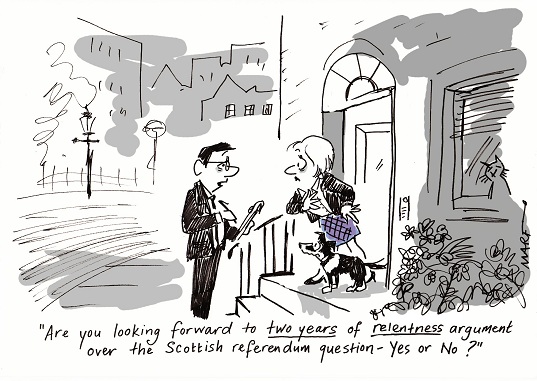
As a Scot, I have been intrigued by the developing rhetoric of the politicians on either side of the upcoming referendum question. They hone their arguments in an attempt to win over voters to one or other side of the debate. Should Scotland be an independent country? Simple enough question, but it sits atop a mountain of uncertainty, doubt and fear.

source: with thanks to Marf (Martha Richler)

source: with thanks to Marf (Martha Richler)

Many people have already made up their minds, and nothing the politicians do during the campaign will sway them from their conviction. They are people who are clear on the question, they are certain what the answer is, and they are in no doubt. But, ultimately, the people who will determine the outcome, are the currently undecided people of Scotland. They remain uncertain, they have doubts, they have no clear conviction.

And what is it that people want to hear from their politicians and leaders when they are unsure? What engages people who are having doubts and uncertainties about the future? Personally, I want to hear leaders tell me that they understand my concerns, that they too have those feelings of uncertainty, that doubt and fear have entered their head too. I am unlikely to respond or relate to yet another ‘conviction’ speech. The sort of argument that suggests that there is no room for doubt. And, yet, what I am hearing, from both sides of the referendum campaign, are entrenched arguments, conviction statements, and a total absence of humility.

Both sides appear to have forgotten Continue reading