When will we stop just surviving?

We become what we focus on.  The surest way to create a habit (for good or for bad) is to focus relentlessly on repeating the same patterns of behaviour and thinking.  And that’s what worries me.  Our companies and organisations have been ploughing pretty much the same furrow for a long time now.

The malaise that has hung over the economy for several years has created a series of habits within our executive population that has seen them become ‘expert’ in running affairs in a very particular way.  Yes, houses needed to be put in order, cost reductions (probably overdue in some areas) were necessary, educating the entire workforce in seeking efficiencies was sensible, and asking tough questions about what was core business for the future, have all been necessary and useful exercises.

So, what’s my concern?  Well, let’s imagine fictitious Company A.  Here, people have stayed in this mindset for too long, to the exclusion of other ways of thinking, a habit has been formed, which has become harder and harder to break. The senior executives and middle managers have become obsessed by cost reduction spreadsheet reviews, incidental expenditure policy changes, efficiency targets that become embroiled in inter-department disputes about double-counting savings, and the policing of travel bans. Accompanying this ‘inward-looking’ focus they have been swamped by demands for more and more metrics, reports and updates to satisfy themselves, and every layer of management, that things are on track, and people are doing what is expected of them. Of course, this has generated an atmosphere which is lacking in trust, resulting in duplicated reporting, with departments wanting to make sure that their own house is in order before sharing numbers to the wider organisation where they may be exposed.

I make no apology, for painting such a depressing picture of what I suggest is the reality of  day to day life in companies, and government departments, up and down countries, in various parts of the world at this time. This all amounts to ‘Managing for Survival’, when what is called for is a mindset of ‘Leading to Grow’.

You may even recognise some of this in your own company or in your own behaviour?  It’s my guess that many executives and middle managers have lost focus and believe that how they are operating is ‘how things are meant to be’. It has taken everyone down in to the engine-room of the ship, leaving no-one on deck or on the bridge, looking out for new land, or blue skies. It has become Continue reading

Are you a popular Leader? Then what are you doing wrong?

If you want to be popular, leadership is probably not for you. At least, not if you want to do it right.

Leading is all about challenging the way things are. If nothing needs changing, if everything is alright the way it is, then fine, enjoy it while it lasts. Of course, people will instinctively resist suggestions that things need to change. Any attempt to challenge the things that people hold dear, such as habits, routines and traditions will be met with strong feelings, opposition, and possibly even aggression. Yes, leading can be dangerous.

But, taking popular decisions to appease those feelings, keeping people sweet, and avoiding the tough messages is not leadership. Leading involves disturbing people, putting provocative ideas out there, and challenging people to face up to tough realities.

Of course, good leaders do not do these things for kicks. They risk upsetting people and being unpopular in order to get people to take responsibility for solving their own problems, taking tough decisions, and facing up to the adaptive work that is always required in any change process.
Leaders who get seduced by people’s appeals to do the fixing for them, to come up with
the answers for them, and to take all the tough decisions, are doing both themselves and the people a major disservice.  Themselves, because ultimately they will be blamed when things do not work out, and the people, because they will have been robbed of a chance to grow, learn and adapt.

Every day, people in all walks of life, have the opportunity to lead and they choose not to.  When you sit in a meeting room and watch and hear people dance around the real issue, you could be the one who calls attention to it. By doing so, you could lead the meeting in a more constructive and adaptive direction. But, you choose not to. It could prove unpopular. You might upset people. Meanwhile, the issue will stay unresolved,and remain the ‘elephant in the room’ for months. More than likely, others are going through the same thought process as you, and everyone loses.

The dangers of leading are well researched and documented in Leadership on the Line by Ronald Heifetz & Marty Linsky.

So, what does it take to be a ‘brave’ Leader – Continue reading

Lessons from a journey through Wales

Life is like riding a bicycle.  To keep your balance you must keep moving                  ~ Albert Einstein

During the last week I went on a solo adventure. I cycled the entire length of the country. Now, before those of you living in places like Australia or the USA get really excited, I need to point out that the country I am talking about is Wales.  But hey, that’s an adventure for me. If you don’t know Wales, it is hilly. From top to bottom, all 250 miles or so of it, are either going up or going down, though I am certain there are many more ups than downs!

It was a superb trip, spread over four and a half days, in glorious sunshine, through some of the UK’s most beautiful countryside.  I had no big plan other than to enjoy the journey and prove to myself that I could rise to the challenge.  As I came toward the end of the road, I began to ask myself what, if anything, I had learned along the way. I cannot report any spiritual awakening, or major personal transformations, I’m afraid, but I thought I would  share with you a few of the musings of my journey.

1. Take Frequent Breaks.  There were many points where I was sure I could not go on.  I was exhausted. The hill was too steep. It was too hot.  No matter how spent I felt, I was amazed how even a 5 min break, with a bit of refreshment and a stretch, was enough to allow me to carry on. It worked, over and over again.  I do have a tendency to work on tasks until they’re completed, often ‘forgetting’ to take breaks. I know now how much more re-focused and re-energised you can be with frequent breaks.

2. Have small, regular goals.  The ‘Big Vision’ – the feeling of completing the journey – is great.  It sets the direction, it inspires you to take on the challenge in the first place, and it helps occasionally to play the picture over in your mind of what finishing will be like (especially when the going gets tough).  But, what got me through was having small targets – the next hill, what’s round the next corner, what’s the next village. This short-term chunking allowed me to focus only on the immediate stage, and not be overwhelmed by the scale of the entire challenge.

3. Rhythm is all important.  This lesson only really came to me later on the journey.  It’s difficult to explain how it happened, as it was something that ‘came to me’ without consciously seeking it. But, it was quite clear that the effort required was much easier once I hit upon a steady, relaxed rhythm.  Fighting against the rhythm is tiring and, on steep hills, I found I ground to a halt the more effort I put in. Relaxing and pumping out a slower, but even, tempo allowed me to go on much longer, and I even began to enjoy hills!

I also learned two other, more trivial, lessons. Continue reading

What’s your favourite Question?

“If I had an hour to solve a problem and my life depended on the solution, I would spend the first 55 minutes determining the proper question to ask, for once I know the proper question, I could solve the problem in less than five minutes.”  (Albert Einstein)

Have you ever thought about the power of questions?  We ask questions all the time but we probably don’t think much about doing it, or what impact our questions are having. There’s more to questions than simply choosing whether to use What, Where, Who, When, Which, How or Why?  Good questions are what drives creativity, discovery and progress.  But, I have a concern that our business culture and organisations do not encourage and reward behaviour that promotes good questions. Instead, our leaders and managers are expected to have ‘answers’ rather than questions and are expected to make decisions and fix problems.  This drives our management cultures toward adopting an ‘advocacy’ rather than an ‘enquiry’ philosophy, reinforcing the expectations of the workforce and of the leaders themselves.

More than ever, we need ‘new thinking’, fresh paradigms, and questions that challenge the ‘way things have always been done’.  Unfortunately, we don’t train people in the skill of constructing powerful questions, perhaps reinforced by the age-old ‘dogma’ that we pay people to come up with answers and solutions, not ask more questions.  Of course this is short-sighted thinking, and it is time to value the power of questions and to invest in the development of this most important of skills.

So, what makes a question ‘powerful’?  Here is a list proposed by Eric E. Vogt, Juanita Brown, and David Isaacs, 2003, in “The art of powerful questions”.

Powerful questions……

  • generate curiosity in the listener
  • stimulate reflective conversation
  • are thought-provoking
  • surface underlying assumptions
  •  invite creativity and new possibilities
  • generate energy and forward movement
  • channel attention and focus inquiry
  • stay with participants
  • touch a deep meaning
  • evokes more questions

A powerful question will also spread across networks of conversation, pervade organizations and communities, and are more often than not the catalyst for large-scale and transformational change.

Here are some examples of the types of questions that I believe have the power to shift thinking, tap in to people’s creativity, and open up possibilities that ‘more conventional’ ways of tackling issues may never discover. Continue reading

Are you a Lighthouse Leader?

I recall a seminar I attended a few years ago, where Chris Nichols (of Ashridge Consulting)  put forward the idea of thinking of leaders as lighthouses.  The concept has taken on new significance at this current time, as I observe businesses flounder, adrift in an ocean of unpredictability.  No business was ever created without a vision, aspirations, goals and dreams of succeeding.  Yet, the prevailing climate, the gloom of the global economy, and the rhetoric of politicians and media commentators, all combine to dampen spirits and encourage business leaders to keep their heads down till conditions change for the better. The trouble with this approach is that this will not help conditions change any time soon.

People tend to feed their emotions on what is around them, and if the only diet available is pessimism, negativity and aversion to risk, then that will, more than likely, become the prevailing culture.

We need leaders to be lighthouses. But, it is no good expecting to be able to navigate your course from a single beacon at the top of an organisation. To be able to steer one’s way successfully we need many lighthouses illuminating our way.  Many leaders, at all levels,  who act as beacons in a sea of darkness.  We need growing networks of lighthouses, whose beams combine to cast increasing clarity.

Those businesses that emerge from the current economic situation, in a stronger, leaner, and more vibrant state than others, are those that are Continue reading

From Conflict to Collaboration

Inter-personal or group conflict is an inevitable consequence of people working together in teams.  In fact, conflict can be a good thing, as it is a sign that people care and are passionate, and, if those energies are channelled correctly, they can be a great source of diverse ideas and solutions.

Too often however, conflict results in negative and damaging outcomes. It can hurt morale, suppress individual effectiveness, and, ultimately, destroy team productivity. Left untreated, it results in a downward spiral of negativity, emotions and blame.

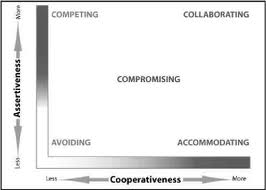
A helpful starting point is to understand some of the theory, and to recognise that people have different (and preferred) styles of dealing with conflict.  There is no one style that will work best in every situation, but once you have an understanding of the different styles, you have the opportunity to step back and think about the most appropriate approach (or perhaps mix of approaches) that will suit the current situation. And, having a raised awareness of your own ‘natural’ style is a good first step to helping you learn and adapt when necessary, so that it does not remain your only style.  (For a deeper treatment of this area, see the work of Ralph H. Kilmann and Kenneth W. Thomas)

The list of styles identified through their work are:

  • Avoiding – Acting in a  way that does not address the conflict directly. This style is typified by delegating controversial decisions, accepting default decisions, and not wanting to hurt anyone’s feelings. It can be a viable style to adopt when the issue and the relationship are of very low importance, but it should be used with extreme caution.  Avoiding a serious issue may make the conflict intensify, possibly damaging relationships further.
  • Accommodating – Involves accepting the other party’s position or interest at the expense of your own.  People who naturally adopt this style are not assertive but highly cooperative. It may be appropriate when the issue matters more to the other party and when peace is more valuable than winning. It can, however, be counter-productive as you may be seen as weak, especially if used repeatedly. Furthermore, constant ‘accommodating’ may lead to increased stress.
  • Competing – Working to have your position or interests take priority over those of the other party.  People who tend towards a competitive style take a firm stand, and know what they want, usually operating from a position of power (whether position, rank, expertise, or persuasive ability). It can be useful in an emergency when a decision needs to be made fast; or when defending against someone who is trying to exploit the situation selfishly. However it can leave people feeling bruised, unsatisfied and resentful when used in less urgent situations.  It is also not a useful style when it is important to generate diverse ideas or multiple solutions.
  • Compromising – Involves each party giving and getting a little in terms of position and interests.  People adopting a compromising style seek solutions that will to some extent  satisfy everyone. This approach depends on everyone being prepared to give up something. It can be useful when the cost of conflict is higher than the cost of losing ground, when equal strength opponents are at a standstill and when there is a deadline looming. It is unlikely to work successfully for issues of principle and may cut off opportunities for collaborative problem solving.
  • Collaborating – Parties attempt to meet all or most of the interests underlying their respective positions.  Collaborators can be highly assertive, but unlike the competitor, they cooperate effectively and acknowledge that everyone’s input is important. This is the most useful style when it is important to bring together a variety of viewpoints to get the best solution; when there have been previous conflicts in the group; or when the situation is too critical  for a simple trade-off.  It is most effective for generating ‘high-quality solutions’ but requires a very high level of trust between parties, and relies on the use of  considerable interpersonal skills (e.g. it is vital  to confront issues directly without threatening the other party). For some situations it may not be appropriate due to the fact that it can take considerable time and effort to implement.

‘True’ Collaboration is an often misunderstood and overused term.  It has been fashionable for companies to Continue reading

What gets in your way and blows the conversation?

Because we are human we have a number of fairly predictable reactions and behaviours in given situations.

All people, regardless of culture, gender, experience, job or position in the hierarchy, operate according to the same set of principles when under even fairly mild levels of stress. [For a more detailed treatment of this area I refer you to Chris Argyris’ work on double-loop learning ] 

  1.  We seek to maximise comfort and minimise negative emotions that means both our own and also the other person with whom we may be interacting at the time. 
  2. We will, at the same time as aiming to maintain a position of comfort, still aim to maximise our chances of winning and avoid losingin other words, we typically want to get our point across, and let others see where the problem lies or solution should come from
  3. And third, we seek to maintain controlwe typically try to put out a feeling of rationality and self-control (even when it is lacking) and aim to maintain control of where the discussion or outcome is going so that we can ‘steer’ others to the outcome we want

All of this adds up to a heady mix of potential problems in our everyday dealings with people – especially when stakes are raised, when emotions rise and when threats start to emerge.  The ways in which these principles and values emerge in our behaviour can differ from person to person – sometimes overtly and sometimes beneath a veneer of control, respectability and respect.  The underlying purpose of these strategies is to avoid vulnerability, avoid risk, and avoid appearing incompetent.

But, before you go away with an overly pessimistic view of the human race, don’t worry. First of all, this is natural, and is, to a large extent, a strategy that has helped us survive as a species through our evolution.  These strategies were necessary in the primeval world our ancestors navigated, but they are deeply defensive strategies, and rooted in a desire for self-preservation.  When they show up in our everyday lives, in meetings, in performance reviews and in relationships, they undermine our effectiveness and get in the way of building productive relationships, they are “anti-learning”, and damage the chances of constructive outcomes.

The good news is that we know about these de-railers and how and when they show up, and we can do something about it.

Fundamentally the approach to overcoming these is simple….. Continue reading

Stretch Goals dull our thinking

I was prompted to write this post after reading Daniel Markovitz’s recent article in HBR in which he makes a really good case for challenging the value of Stretch Goals.  To summarize he makes 3 key statements:

  • Stretch goals can be terribly demotivating.
  • Stretch goals have a dangerous tendency to foster unethical behavior.
  • Stretch goals can also — tragically — lead to excessive risk taking.

The way in which goals, targets and objectives are applied in many of our companies and organisations is now open to question and review. The principles and methods by which they are applied has changed little from the industrial days of their birth.

Within a factory-based model of production, when tasks were well-defined and output easily measured, targets, and especially stretch targets, were useful ways to drive up productivity.  After all, if you wanted to increase widget production by 10%, you worked  people harder, increased the speed of the conveyor, offered bonus targets (or overtime payment), and measured the success of your intervention immediately and directly.

However, most problems and challenges we face today are not of this order. Companies, organisations and governments are looking for creative, innovative solutions to intangible and intellectual problems. We don’t even know the right question in many cases yet, let alone reward people for achieving stretch goals that produce answers that may not even be correct or appropriate. Despite this, we appear reluctant to break away from the traditional factory model of reward and motivation.

The evidence, however, is clear.  Stretch goals and offering people bigger rewards to solve intellectual problems actually has the effect of lowering performance. It is in fact a disincentive.  They work in the case of clear, well-defined and narrowly focused tasks, but with complex, intellectual problems they actually dull thinking and cause people to have too narrow a focus.

This is addressed excellently by Dan Pink in a TED talk on “the surprising science of motivation”. If you haven’t watched this, I thoroughly recommend it to you.

The entire concept is flawed.  The incentives system is allegedly “designed to sharpen thinking and accelerate creativity, and it does just the opposite. It dulls thinking and blocks creativity.” (Dan Pink)

But, let’s be clear. I am not saying that Continue reading

Are you prepared to upset the Apple Cart?

I recently had a conversation with a senior manager in a large global organisation about how he was applying performance management in his area.  What he told me surprised me.  He had a few people in his teams that were clearly not performing as well as they could.  Their contributions, when set against people doing similar jobs in other parts of the business, were lower, and they showed no desire to grow and develop beyond their area of specialism. But the manager appreciated their efforts, saw them as ‘steady-eddies’ and knew they would never be star performers.  They were valuable to him, because they had skills he would find hard to replace, even though he knew demand for those skills were in rapid decline. He saw no point in ‘upsetting the apple cart’, as he put it, as everything was running quite smoothly.  His customer was happy, his team was happy, and he was happy. So, why cause problems?

I asked him how he wanted to be viewed by his team as a leader, when they looked back on their careers.

At first he thought that they would see him as a ‘friendly manager’, someone they could ‘trust’, who ‘looked after them’, and to some extent ‘protected them’ from all of the ‘latest fads’ and ‘initiatives’ that were doing the rounds in the business.  Those ‘fads and initiatives’ that he was referring to are about preparing people for what are major global changes within the industry, that are demanding different skills and ways of working.  People are being encouraged to take responsibility for their own careers, to uplift their skills, and develop new ways of thinking to better prepare themselves for the disruption and challenges that are rapidly emerging.

I suggested that it was possible they would look upon him as a useful buffer and protector from ‘disruptive change’ in the short term (or for as long as their area remains viable), but that in the longer term they are likely to look back and question why others had ‘stolen a march’ on them.

They may be saying things like: Continue reading

We get the Leaders we deserve?

If we accept that successful leadership helps people to take responsibility, to grow and develop, and to make hard choices, then, by definition, when people remain reliant and dependent on others providing answers, guidance and direction, and are content to let others do the work, then the leadership we get is, at best, sub-optimal.

People like to elect or hire leaders to provide them with the right answers, and not to confront them with challenging questions or difficult choices.  But, the great leaders do just that. They do not resort to using their authority to ‘implement their own answers’.  They may set out the vision, they may indicate the general direction we need to follow, but they will also put responsibility back in the hands of people to come up with the answers that are right for them and to be implemented at a pace that is tolerable.

Indeed, the more challenging the problem and the more risks involved, the more that people need to face up to the adaptive pressures and the choices that they face.  And, paradoxically, it is under these extreme situations that leaders come under the most pressure to provide the right answers.

The danger in these situations is that some leaders will Continue reading