You could be excused for wondering whether leadership has gone out of fashion right now. Whether it be politics, business or sport, wherever you look, there appears to be a vacuum at the top, and much discrediting of those leaders who remain.
What could be going on? Well, I think one of the problems is that we are mixed up about
what we want from our leaders. Perhaps we expect too much of them. Should they have all the answers? Should they be all-seeing and all-hearing? Is it reasonable to expect them to set strategy, direction, plan, implement, review, report and make key decisions, as well as dispense wisdom to all who seek it? Of course not. But, despite recognising this as impractical, and even unhealthy, as a society we are still encouraged to demand unequivocal and unwavering surety from our leaders.
At this time, perhaps more than at any time in the past, we need a different set of skills from our leaders. We live in a VUCA(volatility, uncertainty, complexity and ambiguity) world where knowledge is distributed more widely than ever, where more information is instantly available than at any time in history, yet despite all that information, decision-making has never been more difficult. Those who come out of the charismatic ‘all-knowing’ school of leadership present us with dangers. Continue reading →
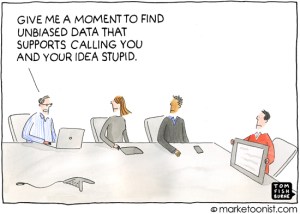
People do not go out of their way to seek data that contradicts their existing beliefs. On the contrary, they will select any data they find that supports existing assumptions. We may like to believe that we are open to having our minds changed, but the reality is that we are quite fixed when it comes to our mental malleability.
Evidence for this assertion is being played out daily on our radios and televisions, as people debate the pros and cons of Brexit. There is an uncanny collective agreement amongst the public that they do not get enough facts to help them arrive at a logical and balanced position. We hear this refrain in panel discussions, question time and vox pops. “How are we supposed to know what the truth is? One lot give us a load of statistics, and then the other lot come along and tell us that is all wrong and hit us with another load of statistics.”
I watched one such programme recently, where a member of the public made exactly this
point. He levelled his accusation at one of the ‘experts’ on the panel. His complaint centred around the costs of running the EU along with an assertion that Britain should not be run by unelected bureaucrats. The expert spent a reasonable amount of time patiently explaining the facts. He explained that calling all of the EU machine unelected was not accurate. He pointed out that the EU Parliament, which is made up of elected national representatives, does in fact have a veto over recommendations put forward by the EU Commission. And that the EU Council is also made up of one member from each state in the EU, each of whom will have been elected as part of their home nation’s general elections. This was all delivered in a tone of neutrality, and with a genuine desire to help alleviate concerns and misunderstandings. At the end, the person who had raised the original issue was asked if the information provided had helped. His response was not positive. Exasperated, he accused the ‘expert’ of simply adding to the confusion and misconceptions, and “just who was he supposed to believe?”
The world is faced with enormous challenges, and we need creativity and innovation more than ever. Whether today’s focus is on climate change, terrorism, economic collapse or disease, the ‘old-world’ thinking that got us here will not be good enough to lead us to where we need to get to.
No one can dispute that the growth of the internet and the explosion of personal device ownership has made available more data to more people in the space of just a few short years than was ever available in the history of humanity. The trouble is that knowledge search algorithms generally assume that volume is good. The more something is searched for, the more privileged it becomes. The information at the top of the list does not reflect quality, it reflects desirability. And, it fosters laziness. Personalisation ensures that we are presented with our ‘favourites’, the things we have ‘said we enjoy’ in the past. Despite the diversity of knowledge that is potentially available, the interfaces through which we access information, ironically, narrows our universe.
As a coach, I have never been one to feel wedded to a particular philosophy or specific model. There are too many rich and interesting ways of thinking out there, and to ignore them because they don’t fit with ‘your model’ seems short-sighted. Also, no two clients are ever the same, and what works best for one person may not hit the mark for another. As such, I believe that having a deep tool-bag of coaching techniques is essential. That way, and with experience of using them, you can start to get a sense of what will work best for different clients.
One area that I have recently borrowed from, and found hugely powerful in coaching practice, is that of ACT (Acceptance and Commitment Therapy). ACT is based upon a model of psychological flexibility (called the ACT hexaflex). The principle being that healthy emotional functioning is achieved as a result of finding a healthy balance of six key processes:
Acceptance
Cognitive Defusion
Present Moment Awareness
Self Awareness
Values
Committed Action
ACT also recognises that the unique nature of human language, while clearly setting us apart from all other life on earth in our ability to plan, predict, evaluate and reason, also traps us inside a cage of emotional suffering. The way we describe ourselves, the world, and how we interact with the world reveals much about our psychological flexibility. Continue reading →
Perhaps ‘the’ most tantalising allure of any advancement in engineering or technology through the ages has been the promise of saving us time. Cars, trains and planes certainly get us places faster than horses ever did. Bridges and tunnels allow us to take short-cuts over rivers and through mountains, saving us hours. Advances in IT and robotics mean that tasks previously handled manually have been automated with exponential levels of increased productivity.
Why, with so much technology and time-saving gadgetry at our fingertips, do people still present at coaching sessions with issues and concerns about their ability to manage their time? After all, our lives have never appeared to be more organised ~ or perhaps I should say digitised! More and more of us are hooked up to the Net from morning to night.
Our smartphones and tablets wake us up, we check our diary for appointments and read our messages before getting out of bed. We catch up on missed shows on iPlayer or Stitcher while we commute to work. We juggle collaborating on Sharepoint, with watching company Webcasts, while occasionally dipping into our personal Instagram, Twitter or WhatsApp accounts. We may even check in on Foursquare while grabbing lunch, and be just as likely to choose where to go by WiFi availability as the quality of the food. On the way home we might burn some carbs, having gained access with our fingerprint or iris, which are digitised on the gym’s customer database. We immediately wire ourselves up to the screens on the machines so as to catch up on news, or check Facebook activity. And when we get home, after a microwaved dinner, and a quick skype chat with your mum, our relaxation and wind down time may well include logging on remotely to your work’s email to ‘finish off’ a few things, and give yourself a fighting chance of making a clean start on things again in the morning (fat chance!).
In the week of the 2015 US Masters golf championship, many eyes are on Rory McIlroy. In 2011, an even younger McIlroy was on the verge of making golfing history. He carried a 4-shot lead into the final round, having played sublime golf for the first three days of the championship. However, on his final round he shot the worst round in history by any professional golfer leading after the 3rd round of the Masters. Not the piece of history he was after. Rory suffered what can only be described as a ‘meltdown’ in the unforgiving glare of the TV cameras and the golfing world.
Some pundits questioned his bottle, his psyche, his temperament, and his ‘big game’ mentality. Some said, “history shows that players who cough up big leads in big tournaments often don’t get another chance, their psyches permanently shattered by thoughts of what might have been.” (TwinCities.com)
But, McIlroy went on to win 4 majors in the next three years, starting with the U.S.Open championship, just a few short months after his Augusta meltdown. He achieved his victory in some style too, setting a new championship record and becoming the youngest winner since 1923. Continue reading →
Few would argue with the notion that self-awareness is a vital prerequisite for any effective leader. It is, after all, a key building block for emotional intelligence (EQ), providing the foundation for greater self-regulation, which in turn lends itself to more astute social awareness and finely tuned social skills, including leadership.
Be careful of false promises however. Many books and articles have been written promising great things on the back of EQ mastery. Unfortunately, many of these words of wisdom miss the point. EQ is not just a set of skills to be learned and used, as simply as switching on a light. True EQ embodies a mind-set and a ‘way of being’ that is imbued with honourable intentions.
It is fashionable, indeed expected, for leaders to be in tune with their emotions, to understand themselves deeply, and to be equipped with the skills to know and read others’ emotions and motivations. There is a danger in this, however. A danger that lies at the very heart of how we expect our leaders to be.
Leaders are expected to know stuff. To know the strategy, to provide the direction, to comfort people during periods of uncertainty, to motivate, and have answers to difficult questions about expected future changes in the market. In short, the buck stops with the leader. It’s what they are paid top dollar for, isn’t it?
And how do leaders typically respond to these expectations? By playing the same elaborate game of course. By giving people what they expect. They put on a brave face (“for the sake of morale!”) even when they are unsure. They feel pressure to come up with answers when put on the spot for fear of looking out of their depth (“you never know – you might eventually be ‘found out’ as being a fraud or over-promoted!”). All the while, they stay outwardly calm, self-assured and in control. In other words, they put all of their hard-learned EQ skills into practice. The veneer of self-assuredness, and being completely in tune with people’s fears and uncertainties, proves the value of the hours spent on the books and courses to master these essential ‘people’ skills. But, wait a minute! Didn’t I suggest that this was all a game?
The truth is that this is playing EQ by numbers and not from the heart. The best leaders trust themselves – warts and all – to operate from a place of openness and honesty. This means displaying vulnerability. Yes, even at the risk of scaring the workforce, by having them know you don’t have all the answers. Leaders who can share insecurities, hand responsibility back to others, ask questions rather than provide answers, and use EQ to learn rather than persuade and manipulate, will earn greater respect and trust in the longer term.
People will sense very quickly if your words and actions have a ‘hollow’, transactional and manipulative tone, even if they are dressed up with the EQ language you have learned. Furthermore, you will be modelling the type of behaviour that will become part of the organisation’s culture and be repeated at every level. After all, being a leader is not about you. It is about the people being led. Are you helping to enhance their capacity and creativity? Are you empowering them to have ideas and to influence strategy? Are they growing and developing as people under your leadership?
Self-awareness is the gateway to great leadership, a prerequisite but not, in itself, sufficient. It is not enough that leaders use emotional intelligence; it is vital that they live it.
***********************************************
About the author: Louis Collins enables people to operate more successfully. You may be struggling to implement corporate strategy, you may want to get more productivity out of yourself or your teams but don’t know where to start, or you may not be having as effective conversations as you could be. I will work with you to enable you to formulate more effective ways of leading, to raise awareness of blockers to successful ways of working, and ultimately to help you and your managers to lead more successfully.
Could your organisation benefit from raising the leadership skills of its people? Would you, or members of your management team, benefit from exploring ways to make significant improvements in personal and/or collective effectiveness and productivity? Coaching around the rich field of leadership will help provide the edge that you are seeking in 2015. Coaching has been proven to directly impact the bottom line. Simply drop me your contact details on the Contact Us page and I will be delighted to speak with you.
“I believe this passionately: that we don’t grow into creativity, we grow out of it. Or rather, we get educated out if it.” ~ Ken Robinson
We live in a world that favours conformity over diversity, despite the fact that no two people are the same. I guess we do this because it seems easier. How could we build a health system, prison system or education system individually tailored to the needs of each and every person who passes through it? That would be impossible wouldn’t it? Well, yes, at the overall organization and administration level that is undoubtedly true, but what about at the point of delivery? Is it really impossible to see each recipient of education, health care or custodial reform as individuals, with different needs and unique histories?
Enjoy this immensely funny, but deadly serious, talk by Sir Ken Robinson, as he warns against the dangers of an education system that favours compliance over individuality, standardisation over creativity.
We need curiosity for learning and for human growth. Intelligence is not simply measured by how many facts you know, but about asking great questions, being endlessly curious and making, breaking and re-creating neural connections, constantly, even into old age. A great education system will provoke, stimulate, challenge and harness people’s innate curiosity.
Creativity is being stifled in far too many of our education regimes around the world. It is, after all, what drives human evolution and cultural development. It is what has made our society what it is today. We are the beneficiaries of our audacious and creative ancestors who dared to dream big, gifting us our transport systems, our medicines, our computers and communication networks, our architecture and our libraries of information. Who will deliver the next generation of dreams?
Unfortunately, and too often, our systems drive cultures of compliance, which ignore the value of the individual in favour of the ‘hollow success’ of the system. Hollow, because no system can be deemed successful, unless the people it is intended to serve are thriving and benefiting from how it is being run. We treat education like an industrial process which can be tweaked and tuned till it is operating like a well-oiled machine. But education is a about humans, individual people, and not about the system.
It does not have to be this way. The countries of northern Europe have been daring to do things differently for some time. Robinson, in his talk, points out that Finland has no standardisation in its schools. They individualise learning, attribute high status to the teaching profession and have no pupil drop-out rate. The Finns are regarded as having one of, if not, the best education system in the world, yet their pupils do not start school until the age of 7, and are not obsessed with exams and standards. Pupils do not sit any formal exams until the age of 16. And it is not only in education that they lead the way. Finland and Sweden can measure the number of under-18s that it hands out custodial sentences to each year on the fingers of one hand. They prefer to deal with young offenders individually by providing treatment, rehabilitation and support, rather than throwing them into the criminal justice system, where they become a statistic and are much more likely to re-offend after release.
Like the rare flowering seen in Death Valley after occasional rainfall, dormant talent can
be reinvigorated. We just need to create the right climate and conditions, and focus on nurturing individual creativity and curiosity. Leaders in education, and in all of our major institutions responsible for harnessing young people’s talent, need to practise less command and control and more climate control.
***********************************************
About the author: Louis Collins enables people to operate more successfully. You may be struggling to implement corporate strategy, you may want to get more productivity out of yourself or your teams but don’t know where to start, or you may not be having as effective conversations as you could be. I will work with you to enable you to formulate more effective ways of leading, to raise awareness of blockers to successful ways of working, and ultimately to help you and your managers to lead more successfully.
Could your organisation benefit from raising the leadership skills of its people? Would you, or members of your management team, benefit from exploring ways to make significant improvements in personal and/or collective effectiveness and productivity? Coaching around the rich field of leadership will help provide the edge that you are seeking in 2015. Coaching has been proven to directly impact the bottom line. Simply drop me your contact details on the Contact Us page and I will be delighted to have an initial discussion.
When we are no longer able to change a situation, we are challenged to change ourselves. ~ Viktor E. Frankl
All learning happens at ‘the edge’. Going to the edge, and looking beyond, creates uncertainty. After all, when nothing is changing and your world is predictable, what is the need to change, or learn anything new? Sometimes changes are forced on us, sometimes they are sought. Either way, they induce learning and growth.
This appears to be at the very heart of our existence as a species. Skulls found in the Great Rift Valley of East Africa, the cradle of humanity, point to increases in skull capacity, and by definition brain size, at specific points in the earth’s history that correspond to periods of dramatic environmental change.
Professor Brian Cox’s recent BBC programme, Apeman to Spaceman, explains that the earth experiences major and rapid climatic changes approximately every 400,000 years. The skulls of various generations of hominin species (i.e. from australopithecus, to homo erectus, through to early homo sapien) reveal an almost doubling of brain capacity every 400,000 years. The theory he advances is that human intelligence is quite literally a response to periods of rapid changes in the environment as a result of violent climate fluctuations.
And while this theory is concerned with enormous changes over thousands of years, the conditions for changes driving growth and learning are no less evident within single lifetimes. Continue reading →
Stop and think! How much of your waking hours do you spend being confused? Or puzzled? Or maybe you prefer to use the the word ‘uncertain’? If the answer is hardly at all, I would suggest you get yourself more confused, more often.
Being certain, being sure, having it all figured out, is not conducive to learning and growth. We are primed for learning when we are at the edge of of our knowledge. When our beliefs are challenged. When the bubbles of our old certainties are popped. Continue reading →

 explaining the facts. He explained that calling all of the EU machine unelected was not accurate. He pointed out that the EU Parliament, which is made up of elected national representatives, does in fact have a veto over recommendations put forward by the EU Commission. And that the EU Council is also made up of one member from each state in the EU, each of whom will have been elected as part of their home nation’s general elections. This was all delivered in a tone of neutrality, and with a genuine desire to help alleviate concerns and misunderstandings. At the end, the person who had raised the original issue was asked if the information provided had helped. His response was not positive. Exasperated, he accused the ‘expert’ of simply adding to the confusion and misconceptions, and “just who was he supposed to believe?”
 No one can dispute that the growth of the internet and the explosion of personal device ownership has made available more data to more people in the space of just a few short years than was ever available in the history of humanity. The trouble is that knowledge search algorithms generally assume that volume is good. The more something is searched for, the more privileged it becomes. The information at the top of the list does not reflect quality, it reflects desirability. And, it fosters laziness. Personalisation ensures that we are presented with our ‘favourites’, the things we have ‘said we enjoy’ in the past. Despite the diversity of knowledge that is potentially available, the interfaces through which we access information, ironically, narrows our universe.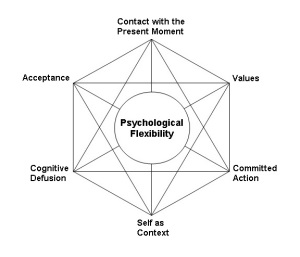





 Gyro Consulting Services