Are you in Control? Time to let go.

Imagine yourself riding a motorcycle in a high-speed race. You are at full throttle going round the final bend. Only a delicate balance between gravity and centrifugal forces are preventing you from flying off the track. At that moment, are you in control of your bike, or are you out of control? The answer is you are ‘right on the edge’. Too much ‘in control’ and you probably aren’t taking enough risk, and are unlikely to win the race. Too much ‘out of control’ and the likelihood is you are in for a very painful crash.

In your life, are you in control or out of control? Or, have you found the right balance – not just for you, but for your teams, your colleagues, and for your organisation? Are you pushing the limits constantly, in order to win the race, and, as a result, are you in danger of spinning out of control? Or, are you driving a safe race, within the pack, within your comfort zone, making sure you finish, but never in danger of winning? What about the people you see around you? Do you recognise the cruisers and the risk takers?

The reality of course is that Continue reading

Silencing the left brain

Last week’s post on the ‘Upstairs & Downstairs Brain’ attracted considerable attention, and elicited a number of responses – some favourable, some challenging. It appears that the implications of neuroplasticity are still very much at the early stage of consideration for many people, and, just how the new knowledge being generated can be put to use by coaches is not yet clear.

Last week, I spoke about the limbic system (or old brain) as being ‘downstairs’, and the pre-frontal cortex (or new brain) as being ‘upstairs’. Today, let’s look at the brain from a different perspective – left and right.

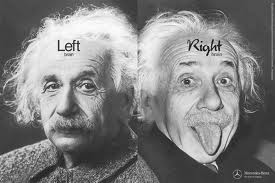
It has long been known that the left & right hemispheres of the human brain specialise in different areas of cognition, memory and reasoning. Put simplistically, the left side of the brain tends to be associated with more logical and analytical thinking, while the right hemisphere is linked to more creative pursuits and expressions of emotion, for example, through art and music.

source: hoffmanprocessuk.blogspot.com

Furthermore, Dr. Jordan Grafman, of the National Institutes of Health (NIH), puts forward evidence that the left-frontal lobe in a normal brain is specialized in storing of individual events, while the right-frontal lobe draws out themes and connections. People who have suffered damage or lesions to their right-frontal area often find it difficult to understand the point of a story, or a movie that they watch, and find the use of metaphor and simile extremely challenging. They understand the words spoken, and can make literal sense of things, but they lose the ability to interpret, extrapolate, find abstract meaning and so on.

But, from studying these unfortunate cases of people who have suffered brain damage, neuroscience has also discovered something fascinating about the way the hemispheres of the brain operate together. Some people who suffer damage or wastage in the left side of their brain, thereby losing their ability to understand the meaning of words, have been known to almost spontaneously develop unusual artistic and musical skills. In other words, skills that are typically processed in the right side of the brain. What is going on here?  Well, Dr. Bruce Miller, a neurology professor at UC, San Francisco, argues that the left hemisphere would normally Continue reading

The Upstairs & Downstairs Brain

Advances in neurosciences continue to inform our understanding of what makes us human, and perhaps even more importantly, how we interact with each other. In this week’s post I recommend two excellent speakers and experts in the field of neuroscience to you, Dan Siegel and Sarah-Jayne Blakemore.

We have passed through many periods of popular assumptions about the brain and the mind, including the tabula rasa (blank slate) theory that humans are born void of knowledge and acquire ideas and wisdom over time from the world in which they operate. And, until a few years ago, we believed that the wiring of our brains was pretty much determined and complete within the first few years of life. Advances in techniques for studying the brain, in recent years, have shown that development continues well into adolescence (and beyond), particularly in the pre-frontal cortex.  During this period of development an especially important process takes place. Synaptic pruning. Underused synapses and connections in the brain are pruned, just like weak or dead branches on a rose bush are cut away.  This is a vital phase of development of the brain, during which connections that are used are strengthened and those which are not are lost. Neurons that fire together wire together. (See also previous post on this subject: The “white stuff”, and what it means for your brain – March 2012) Continue reading

Did the earth move?

As a Leadership Coach of a number of years, I may be about to say something that upsets my fellow coaches, or worse, loses me future business as a coach! But, I’ll risk it for the sake of sharing what I believe needs to be said.  As coaches (and probably as clients too) we shouldn’t expect too much from the ‘coaching session’ itself.

What do I mean by this?  Well, I know there are coaches (and I have had this feeling too at times), who worry that, if the ‘earth doesn’t move’ for their clients during the coaching session, they must being doing something wrong.  We dream of our clients having ‘eureka’ moments, where the lights go on, and the path to their future vision becomes clearly illuminated.  Not only is this an unrealistic expectation (at least on each and every coaching engagement), it also ignores the fact that people are very different in the way that they process information and how they deal with issues of change.  I speak from personal experience in this matter.

There have been times, when I have been receiving coaching, that I have worried about how I have been showing up in the session. Sometimes I have felt less than engaged, or sensed that I had made the session unnecessarily challenging for the ‘poor coach’. I know (with my coach’s hat on) that I needn’t have worried about that. Coaches, are, after all, professionally trained and skilled in both supporting and challenging their clients, as appropriate, however they show up.

What I do know, from personal experience, is that my ‘eureka’ moments have tended to happen far away from the coaching session, and at moments when I am least expecting it. You see, I like models and frameworks. I enjoy concepts, paradigms and theories. My preferred method of processing information Continue reading

Throw away the ladder and start climbing

Do organisations and companies really still talk about the ‘career ladder’?  Well, it seems they do. They still live on in the minds of people and, some companies and organisations do still promise rising talent a fast-track route up the ladder, in return for loyalty and extended service.

Reading Leadership Freak’s post today,  I was inspired by a much more meaningful metaphor for the 21st Century than the ‘career ladder’  –  that of “The Climbing Wall”.

photo source: journal.davidbyrne.com

Multi-directional  While ladders are unidirectional, stifling and create ‘log-jams’, on a climbing wall you may move laterally as well as vertically. You may even choose to take a downward step in order to gain a more favourable foothold that will help propel you on an upward journey.

Keeping Options Open  The climbing wall allows you, at times, to have your feet in two different places. Having ‘a foot in two camps’ as you navigate your career, allows you to weigh up your next best move. This may temporarily be challenging, but It keeps your options open, and provides greater flexibility. We are increasingly seeing people operate in this way in the world of work, having more than one job, straddling disciplines, and changing career more often.  The possible routes you can take on a wall are endless, limited only by your imagination, while the traditional ladder concept makes it difficult to change, typically forcing you to come off the ladder and start again on a new one.

photo source: photography.nationalgeographic.com

Cooperation  You also have more opportunity to cooperate while on a climbing wall than you do on a ladder. People can more easily climb side by side, learning from a mentor perhaps, or with a coach who is simultaneously supporting and challenging.  You can also see people who may be in your way, you can take detours and move around them, rather than sit patiently waiting for them to move up the ladder ahead of you.

Breadth and Diversity  Multi-directional “wall climbing” in organisations, connects you with so many more people, aiding diversity, creativity and collaboration. Of course, we need deep specialists, and, in some technical areas, such as medicine, engineering or law, it is important that people become ‘expert’ in their chosen discipline.  However,  everyone can benefit from a broad awareness of other functions and disciplines, helping them become even more successful in their chosen speciality in the long run.

In today’s economic climate, possessing  a breadth of skills and experience is vital, and being ready and prepared to move in different directions, as circumstances change, is an essential asset.  Waiting your turn on the ladder, blinkered to what is going on around, is a dangerous strategy, leaving you exposed in a rapidly changing world.  In evolution, those best able to adapt, survive. Being fleet of foot, multi-skilled and able (and willing) to change direction, are the attributes that will help people thrive in this rapidly-changing and increasingly unpredictable world.

To discuss your future career aspirations and consider how you can enhance the flexibility, resilience and adaptability you will need to succeed, simply submit your contact details on the Contact Us page and I will be delighted to contact you for an initial chat.

Woody – Leading without authority

2012 is the 100 years anniversary of the birth of Woody Guthrie. Woody is a legend and is recognised as the “grand-daddy” of folk music tradition. But he was much more than that. He was a poet, a writer, and a social commentator. He spoke out against injustice at a time when it was dangerous to do so. He inspired new generations of musicians, from Bob Dylan to The Clash.

I attended a tribute and celebration to Woody this week in the traditional coal-mining community of Treorchy in the South Wales valleys.  This was led by Billy Bragg, who has worked closely with Woody’s daughter Nora, to put music to lyrics by her father that had never been recorded. Billy, like Woody, is a songwriter and performer in the Guthrie mould.  Politically active, angry about injustice, optimistic about humanity.  It was a touching, funny and moving tribute, where Bragg warmly and respectfully held up a lens into Woody’s world and into his incredible mind.


His legacy is enormous and more than I could ever do justice in this short post.  To discover more about Woody go check out the official website.  I do, however, want to highlight some words he penned that he called his New Years Rulin’s. These words were written as simple resolutions, and, although simple, are both profound and meaningful words of wisdom that would not look out of place in any self-respecting ‘self-help’ book….This is a selection of his Rulin’s (for a look at his original list in full go to this link)

  • “Dream Good”
  • “Stay Glad”
  • “Keep Hoping Machine Running”
  • “Love Everybody”
  • “Make up your Mind”
  • “Read lots Good Books”
  • “Learn People Better”
  • “Help win War – beat Fascism”       (note: Woody was not afraid to dream big and believe that his music could achieve big things. He famously had the words “This machine kills fascists” written on his guitar).

How appropriate might these simple guidelines be to leaders, in all walks of life, today?

Woody Guthrie was a special kind of leader. He had no formal authority, he had no position of power.  He did not command political position, nor did he operate within corporate, government or religious frameworks. Yet, he Continue reading

Employee Engagement and the Half-Time Team Talk

Employee Engagement. Hackneyed phrase or holy grail? Having recently read the MacLeod/Clarke report to the British Government (Engaging for Success: enhancing performance through employee engagement) on the subject, I am convinced that a) there is currently no better way of describing it and b) it is fundamentally important. To quote from the opening section, “If it is how the workforce performs that determines to a large extent whether companies or organisations succeed, then whether or not the workforce is positively encouraged to perform at its best should be a prime consideration for every leader and manager, and be placed at the heart of business strategy.”

I will leave you to delve into the rich findings, recommendations and case studies in the report, and I do recommend it to anyone with a passing interest in the subject of employee engagement. Here, I will simply draw out some of the barriers organisations feel inhibit effective engagement, together with the key principles highlighted that are imperative for successful implementation.

Barriers

  • Lack of Awareness.  Some leaders are not aware of employee engagement and what it can do for them. Others are reluctant to get involved, concerned that it may be seen as too ‘soft or fluffy’.
  • Uncertainty about Starting.  Some who are interested are unsure how to get involved and started, sometimes fearful that it has to involve ‘buying a product’ and therefore entail expense.
  • Culture.  The prevailing culture and working practices get in the way of delivering engagement, even when leaders place great emphasis on it. Managers may not share the belief, and attempts to implement can be resisted.
  • Underestimating engagement. Some see employee engagement as another job on a tick-list that is achieved when the annual staff survey is completed.

Enablers

  • Leadership.  The importance of a Leadership vision (or ‘strategic narrative’ as it is described in the report) cannot be overstated. A widespread understanding of purpose, and each person having a clear view of how their role contributes to that purpose is paramount.
  • Engaging Managers.  While it is key that Leaders set the purpose, vision and direction, it is the engaged manager who is at the “heart of success” in any workforce.  As one contributor to the report said, “the line manager is the lens through which I see the company and the company sees me.”
  • Voice.  Providing employees with a voice – so that they are listened to, are not fearful of raising issues, know that their views will be heard and could be used to help define and change the direction of the organisation.  This is, of course, a cultural challenge for many organisations where ‘token gesture’ attempts to implement ‘speak up’ policies have failed to penetrate the DNA.
  • Integrity.   Consistency across the organisation between stated values and behaviours. “If an employee sees the stated values of an organisation being lived by the leadership and colleagues, a sense of trust in the organisation is more likely to be developed, and this constitutes a powerful enabler of engagement.”

Regular readers of my posts will know that I enjoy looking to sport for leadership lessons and parallels. So, this week, my attention turns to Continue reading

Don’t let Goals dilute your Purpose

There are many words used to describe the things we do and the reasons we do them.  Objectives, targets, vision, dreams, goals, purpose, KPIs (ugh!), and I’m sure you can think of more.

Let me simplify this down to just two on this list.  Purpose and Goals.  Goals can play an important role in ensuring we stay focused. They provide us with milestones on a longer journey. They help us maintain momentum during periods when we might otherwise be distracted or lose some sight of our purpose. Goals on their own, without a bigger purpose, however, can cause us to drift aimlessly. It is important to periodically ask yourself the question “What purpose does achieving this goal serve?”

Too many leaders, managers, and teams of people in our corporations, find themselves participating in the annual game of concocting targets, objectives and goals, which then dominate meeting agendas, reviews and reports, often taking on a life of their own, and a level of importance that detracts from what ought be the real ‘purpose’ of the business.

Let me use an example from Continue reading

Don’t give me bad news

Nancy Kline in her superb book Time to Think describes a conversation with a senior civil servant whose department was going through wave after wave of changes to the way work was done and how things were structured. When asked how his managers were coping  with all of this, he responded, ‘I have no idea.  I don’t ask them.’  When asked ‘Why?’, he said, ‘They might tell me. We couldn’t have that.’  As Nancy goes on to explain, what he was really saying was thathe couldn’t handle that”.

How common is it for managers to shy away from facing up to the reality of what is going on around them, particularly when it might involve a face-to-face conversation with someone?  Very common, in my experience.   Confronting bad news, delivering home truths, providing feedback on performance, addressing inappropriate behaviour, or challenging resistance to change.  All of these scenarios present managers with situations which they either feel ill-equipped to handle effectively, or they ignore.

When managers fail to recognise an under-performing member of their team, there can be any number of underlying thinking errors or limiting beliefs at play.

For example:

  • They don’t want to admit they have someone under-performing as it may reflect badly on them
  • They don’t want to face the issue directly (it’s not in their nature), and they’re worried about handling any conflict that facing up to it might cause
  • The work is getting done to an ‘adequate enough’ level. Even though the individual is not adding as much as they potentially could, everyone’s reasonably happy – so why rock the boat?  (I dealt with this specific case in more detail in a previous post called Are you prepared to upset the Apple Cart?)
  • The individual is reasonably effective in some areas, so why not overlook or downplay issues in other areas where things could be better?
  • It is just a fact of life that some individuals are weak in certain skills or habits. We can’t change that.
  • The manager has been ‘friends’ with the individual and they’ve worked together a long time. They find it hard to confront them with hard messages.
  • The individual is a “nice” person, and it would hurt them to come down too hard on them
  • The individual is “slick” in that they always have a reason/response to issues raised with them, it’s just not worth the hassle of bringing up problems. After all, we’ve always managed to work round them in the past

Holding back, and not acting with complete honesty or sincerity does not create or encourage learning and improvement?  It does not prepare people for the future and help them adapt to change.

Fundamentally the approach to overcoming this type of ‘limiting thinking’ is simple….. Continue reading

When conflict works

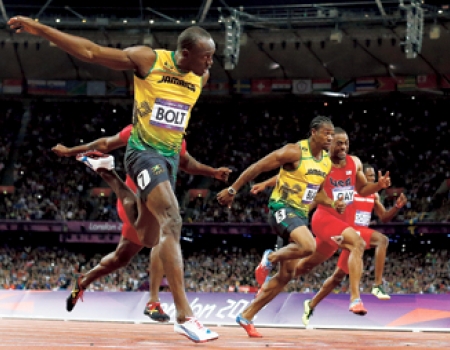
It seems to me, from reflecting on the Olympics, that truly great performances benefit from having someone else to ‘bounce off’. On occasions this can be achieved by colleagues in the same team pushing each other to ever higher levels, as evidenced by the Jamaican sprinters, Usain Bolt and Yohan Blake. It may also be achieved by fierce but respectful rivalry, where the standards of excellence set by one player forces the other to have to raise their game to heights they would not otherwise have to. The phenomenal standards of performance displayed by the world’s top tennis players is evidence of this. It is debatable whether Nadal would ever have reached the level of peak performance he has, if he was not asked some extraordinary questions on the tennis court by Federer. Djokovic has since had to take his game to even greater heights to become World number one. Whether friendly or fierce rivalry, in elite sport, the tensions, pressures, and challenges set, help motivate participants to keep raising their game.

But it is not only sport that can benefit from rivalry, conflict and challenge. Used effectively, disagreements and tensions can be hugely important in driving up standards in all walks of life.

This is illustrated most powerfully in this short clip of Margaret Heffernan, describing the inspiring story of Alice Stewart, an epidemiologist who struggled against the medical establishment to prove that x-rays on pregnant mothers were responsible for childhood cancers. During a long, and often lonely battle, to prove her case, Alice relied heavily upon a colleague, who was quite the opposite from Alice in many ways. His job, as a statistician and as a friend, was simple. To try to prove Alice’s data and results wrong. His job was to create conflict around her theories. Subjecting her work to this level of challenge and scrutiny, provided Alice with greater confidence about the validity of her theory, and helped her to find the energy to persist against formidable opposition.

So, how willing are we in the business world to be so open to this level of ‘voluntary’ challenge and conflict? To what extent are we willing to invite disagreement in the interest of true collaboration?  Continue reading