Overcoming the Brain’s Negativity Bias

We didn’t get where we are today by being positive you know. Oh no.  Survival is a tough, uncompromising business.  Our ancient ancestors needed the negativity bias that is neurally wired into our brains in order to be successful. And successful they were; the fact you are reading this today being proof of that. The paradox is that this very successful survival mechanism – ‘the negativity bias’ – can often get in the way of people being able to experience life positively.

Let’s look at a simple model of how the human brain has been built up over tens of thousands of years of evolution.  (see also Rick Hanson’s article on this subject).          We can think of it as being composed of three (evolutionary) layers:

1. The Lizard Brain            This is the ‘old brain’. It shares many characteristics with the reptilian brain. It tends to fire in a reactive way. It is alert to dangers.  One classic and well-know example that is often quoted is the ’emotional hijack’ – when our emotions take over and we can actually feel like we are at the mercy of another brain. In some ways that is true.  When the ‘red mist’ falls across our eyes in moments of fury or fear, the lizard has taken over the controls.
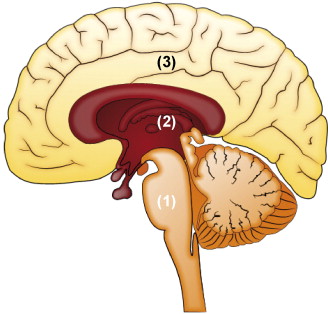
2.   The Mammalian Brain      The middle layer of the brain, which we share with other mammals (in an evolutionary sense) is much more concerned with seeking rewards. More sophisticated processing takes place at this layer than in the ‘old brain’, although in neuroplastic terms it is still relatively ‘rigid’.

3.  The Primate/Human Brain    The most recently developed, upper layer of the brains of primates and humans is concerned primarily with attachments and relationships.   We see this most clearly in the use of communication, language, social network development and extracted thought concerned with abstract concepts such as philosophy, religion and science.

Some of the most recent advances in the science of neuroplasticity have started to reveal amazing abilities for the brain to change and alter shape (by creating new connections and thickening existing connections) as a result of experiences and repeated use.  While neuroplasticity can, and does, take place at all three levels of the brain, it does appear that it is much more difficult to affect changes in the lizard brain than in the primate/human level (or neocortical region) of the brain.  For a superb in-depth treatment of this area, I refer you to Rick Hanson, author of Buddha’s Brain.

Why is this important?  Well, it means that, no matter how sophisticated and developed our thinking becomes, no matter how much we believe we have our emotions under control, there is, deep within our 21st Century selves, a part of us which is operating on one simple rule, which is basically “Get Lunch – Don’t Be Lunch!”

Now, even in the wild, most anxious episodes resolve fairly quickly.  The highly attuned Continue reading

From Curiosity to Attention

“You had my curiosity. But now you have my attention.”                                              as spoken by Leonardo DiCaprio’s character (Calvin Candie) in the move ‘Django Unchained’

“Be curious” is a very popular term used widely within the coaching fraternity.  It is of course great advice, as it encourages people to ‘simply notice’, without judgement, and with an open questioning mind. Being curious helps raise self-awareness. It also encourages one to consider and reflect on things that may otherwise go unnoticed. However, merely ‘being curious’, in itself, is unlikely to create the sufficient mental conditions for significant learning and change to occur. To achieve this, generalised curiosity needs to be cranked up to a state of sharply focused ‘attention’.

Being curious is the equivalent to being a casual ‘observer’ of the game. Having focused attention requires you become completely ‘immersed’ in the game.

source ackowledgement: crit365.com

source acknowledgement: crit365.com

I have touched on this subject many times in the past, most notably in Slow Down, you Move too Fast.  Before getting to agreements that something needs done about a problem, and long before specific actions are decided upon, it is vital that high levels of attention are shone on the issue. People simply do not agree to take action on situations unless they first of all recognise that it is important enough to do so, and that there are high enough stakes at play to make it worthwhile. Continue reading

Are you ‘On the Bank’ or ‘In the Flow’?

“It is not required that we know all of the details about every stretch of the river. Indeed, were we to know, it would not be an adventure, and I wonder if there would be much point in the journey.” ― Jeffrey R. Anderson

Where do you find yourself most often as you wend your way on life’s journey?  Are you firmly in the midst of the river, going with the flow, navigating the hazards and enjoying the thrill of the ride?    Or are you bumping along the banks, stopping regularly to re-appraise the situation, before venturing tentatively back in to the turbulent currents in mid-stream.

source: sea2summit.net

source: sea2summit.net

The ‘river’ metaphor is very useful, and works on many different levels. I listened this week to Dan Siegel (the neurobiologist and author of Mindsight, among other recommended reads) as he discussed the nature of the mind. He spoke about the healthy mind as being integrated and harmonious (‘in flow’), and characterised the troubled mind as tending toward being either ‘chaotic’ or ‘rigid’ in manifestation.  He refers to these two states as being like opposite banks of a river. When we drop out of ‘flow’ – the balanced state of coping, experiencing well-being, and functioning optimally – we tend to drift toward one or other bank. (see Mihaly Csikszentmihalyi for a detailed treatment of ‘Flow’). Which bank you end up on will depend on the condition and situation being experienced, but people also tend to have a dominant bank they gravitate toward. Continue reading

Discard the new year speech

Another year begins. You are re-charged and ready to hit the ground running.  You’ve spent time thinking about all those issues and challenges that need tackling and you are determined to get things moving.  Before you dive straight in, and start giving the big motivational speech, consider whether this might be the year to tackle some things in a new way.

source: guardian.co.uk

source: guardian.co.uk

What different results might emerge if you considered some of the following ‘alternative’ ways of engaging and ‘energizing’ your people?

Giving away Ownership   Instead of spelling out what you want done in precise detail, just paint a picture and outline the general direction.  Allow room for people to be creative, innovative and own the solutions.  They may just surprise you. They’ll get greater satisfaction than they do when implementing someone else’s solution, and will most probably do more than you expected.

Demonstrating Trust   You’re always busy, and often feel compelled to ‘catch up on things’ every time you are back in the office.  What if you were to make it clear that you Continue reading

Resilience in the moment

“A good half of the art of living is resilience.” ~ Alain de Botton.

As companies embark on another tough year ahead in 2013, and a climate of ongoing uncertainty, they are increasingly placing ‘resilience’ as one of the most important qualities they are looking for in their people. But, how do you recognise resilience in people, and how do you help people develop it further?

GlaxoSmithKline have defined ‘resilience’ as: “the ability to succeed personally and professionally in the midst of a high pressured, fast moving and continuously changing environment”.  

Traditional views are reflected in the language often used to describe resilient behaviour:

  • “Bouncing back after being knocked down”
  • “Taking the blows and coming back for more”
  • “Living to fight another day”
source: northjersey.com

source: northjersey.com

These expressions are adversarial and have their roots in war-like and conflict-driven situations. It is arguable that a mind-set of resilience, steeped in this language, is likely to generate more friction than collaboration.

  • What would it feel like to be resilient ‘in the moment’?  Not walk away to ‘re-group’ and then come back re-charged and ready for the fight.  Not retreat in order to re-think your strategy and make sure you win the argument the next time.  
  • But instead, there and then, you were to demonstrate emotional resilience, to really hear what was being said?
  • What if you could ‘flip’ the situation, get behind what was being said, and assess the dynamics objectively and not react?
  • What if you could show genuine curiosity in what’s happening, to hang around long enough to ask questions, to listen deeply, and to hear people out?
  • What might happen once they have been heard?  What different level of engagement might then be possible?

Continue reading

Enough v Perfect? You choose.

I am enough!

As a leader, would you ever tell your people they are “Already enough”?  What would stop you saying that?  Have you ever said to yourself, “I am enough”?

with thanks to: Hugh at gapingvoid.com

with thanks to: Hugh at gapingvoid.com

Doesn’t it amount to an admission of defeat? Isn’t it saying I can’t get any better? Where is the ambition in the word “enough”? It is surely the antithesis of everything we aspire to. To keep improving, to become more effective, to control, to perfect. To be perfect.

But, think again. We are a society riddled with uncertainty. As a result we battle against that uncertainty and it comes out as anger, as fear, and with bitterness. The more scared we get, the more certain we become in our beliefs. The angrier we get, because others just don’t get it, the more it results in increased frustration and fear. A vicious cycle of fear, anger and increasing uncertainty.The struggle to attain is driven by ever rising expectations. Expectations from where? From parents, from peers, from ourselves? The pressure to be the best you can be, to maximise your potential. They are well-meaning expressions, I find myself using them as self-motivators, what harm can they do? The trouble is, they don’t come with an instruction manual. No-one ever knows Continue reading

What’s a genius anyway?

Pablo Sarasate (violin virtuoso) stated “A genius!  For 37 years I’ve practiced 14 hours a day, and now they call me a genius” (cited in Simonton, 1999) *.

Last week I wrote a post called ‘Stroke of Genius’ and it attracted a pretty high level of interest. Clearly a popular topic. And many comments I received were along similar lines, mentioning that identifying talent in the first place is often the most difficult challenge faced. I figured that I owed it to myself and readers to address this area in today’s post.

source: blog.kennedyviolins.com

source: blog.kennedyviolins.com

Well, right up front, we need to think about recruitment.

Recruiting talent
Do you know what you are looking for in the first place?

This is not as simple a question as it might first appear. For example, if you are a company, can you answer the following questions?

  • What does the company look like today, and what will it look like in two, three, or four years time?
  • What is the company’s medium to long term strategy?
  • What sort of people will it need to succeed in that strategy? Same as today or very different talent?
  • What sort of roles will be most critical in the future? And how much market demand will there be for those people?
  • What aptitudes will it take to operate in these future positions?

Are the people who are making recruitment decisions and identifying talent sufficiently aware of the future strategic plans for the business? Or are they blindly cultivating talent based on a model of today’s business? Continue reading

Stroke of Genius

I was intrigued by an article I read this week on 5 Reasons Your Top Employee Isn’t Happy. It got me thinking about how we manage talent.  And maybe there lies the problem – in that very word ‘manage’.  Talent is a precious thing, but should it be given ‘maverick status’ or does it need to be controlled?  Well, I guess the answer might well vary depending on the culture of the company, what period in the company’s development you are at, or what sort of leader you are?

source: bbc.co.uk

source: bbc.co.uk

I immediately thought about the football team analogy. I have played and watched football over more years than I care to remember, and the recurring debate about how teams should accommodate rare talent just never goes away.  What I have seen,  is that teams who are riding on the crest of a wave, winning everything in sight, and blowing the opposition away, can often afford the ‘luxury’ of the occasional ‘maverick’ or ‘outlier’.  Often described as a genius, these players entertain the crowds and keep the sports (and sometimes front-page) writers happy.

But, when the going gets tough, everyone is expected to put in a shift. Sulking on the wings with your hands on hips, complaining about not getting good service, doesn’t go down well – not with the crowd (or shareholders), team mates (or work colleagues) or coach (boss).

It’s a big issue for companies too. When someone is bestowed the title talent (or genius) – what is expected of them and of others?   Continue reading

Get Less Busy

source credit: geniusbeauty.com

People in our workforces are under serious strain.  They are constantly being asked to do more with less. Our businesses and government departments are responding to the austerity drives by trimming more and more from their budgets, which inevitably means fewer people are left to do the work. Meanwhile the demands are increasing. With everyone in the economy tightening their belts, company profits are falling, which means that a smaller and smaller workforce is being challenged to work smarter, harder, more innovatively and to ‘keep their chins up and stay engaged’.

In the midst of this, what are our leaders getting up to?  Well, from what I can glean, I see leaders who feel a great deal of responsibility for this state of affairs, and who are responding by working themselves harder and more intensely than ever.

The irony is, that at this time, perhaps more than ever before, our leaders need to be making themselves much less ‘busy’, and focusing more than they ever have done on nurturing their workforce.So, what can we be asking our leaders to be thinking about right now that will help them to do just that? Continue reading

Don’t Lose the Plot

“Life is a journey, not a destination.”  ~ Ralph Waldo Emerson

I can’t imagine many people will not have heard (or used) this quote – or a variant of it – at some time in their lives.  It does seem fairly self-evident I guess.  People who set out on any journey, whether they get to where they imagined they would or not, do at least get the satisfaction of knowing that they tried. They have the opportunity of enjoying the thrill of the ride. They gain experience and learning from the venture. The challenge of the journey will often, in itself, be a major part of the reason for embarking on it.  Isn’t that obvious?
"It's A Long And Winding Road..."

Well, Intuitive though this may sound, it does not always appear that way when observing people’s behaviour. How many people are genuinely enjoying their journeys?I watched a documentary on TV this week, in which Ian Rankin (the famous and brilliant crime writer – check out his Rebus novels if you don’t know about him) keeps a video-diary of his thoughts, activity and progress while writing his latest novel.  He has a sketchy idea for the plot and how to start it off, and a vague notion of how the book should end, but has no idea how he will fill the 300 or so pages in between. For Rankin this was very much a process of discovery. It was as though he were chopping and beating a path Continue reading