From Curiosity to Attention

“You had my curiosity. But now you have my attention.”                                              as spoken by Leonardo DiCaprio’s character (Calvin Candie) in the move ‘Django Unchained’

“Be curious” is a very popular term used widely within the coaching fraternity.  It is of course great advice, as it encourages people to ‘simply notice’, without judgement, and with an open questioning mind. Being curious helps raise self-awareness. It also encourages one to consider and reflect on things that may otherwise go unnoticed. However, merely ‘being curious’, in itself, is unlikely to create the sufficient mental conditions for significant learning and change to occur. To achieve this, generalised curiosity needs to be cranked up to a state of sharply focused ‘attention’.

Being curious is the equivalent to being a casual ‘observer’ of the game. Having focused attention requires you become completely ‘immersed’ in the game.

source ackowledgement: crit365.com

source acknowledgement: crit365.com

I have touched on this subject many times in the past, most notably in Slow Down, you Move too Fast.  Before getting to agreements that something needs done about a problem, and long before specific actions are decided upon, it is vital that high levels of attention are shone on the issue. People simply do not agree to take action on situations unless they first of all recognise that it is important enough to do so, and that there are high enough stakes at play to make it worthwhile. Continue reading

Discard the new year speech

Another year begins. You are re-charged and ready to hit the ground running.  You’ve spent time thinking about all those issues and challenges that need tackling and you are determined to get things moving.  Before you dive straight in, and start giving the big motivational speech, consider whether this might be the year to tackle some things in a new way.

source: guardian.co.uk

source: guardian.co.uk

What different results might emerge if you considered some of the following ‘alternative’ ways of engaging and ‘energizing’ your people?

Giving away Ownership   Instead of spelling out what you want done in precise detail, just paint a picture and outline the general direction.  Allow room for people to be creative, innovative and own the solutions.  They may just surprise you. They’ll get greater satisfaction than they do when implementing someone else’s solution, and will most probably do more than you expected.

Demonstrating Trust   You’re always busy, and often feel compelled to ‘catch up on things’ every time you are back in the office.  What if you were to make it clear that you Continue reading

Resilience in the moment

“A good half of the art of living is resilience.” ~ Alain de Botton.

As companies embark on another tough year ahead in 2013, and a climate of ongoing uncertainty, they are increasingly placing ‘resilience’ as one of the most important qualities they are looking for in their people. But, how do you recognise resilience in people, and how do you help people develop it further?

GlaxoSmithKline have defined ‘resilience’ as: “the ability to succeed personally and professionally in the midst of a high pressured, fast moving and continuously changing environment”.  

Traditional views are reflected in the language often used to describe resilient behaviour:

  • “Bouncing back after being knocked down”
  • “Taking the blows and coming back for more”
  • “Living to fight another day”
source: northjersey.com

source: northjersey.com

These expressions are adversarial and have their roots in war-like and conflict-driven situations. It is arguable that a mind-set of resilience, steeped in this language, is likely to generate more friction than collaboration.

  • What would it feel like to be resilient ‘in the moment’?  Not walk away to ‘re-group’ and then come back re-charged and ready for the fight.  Not retreat in order to re-think your strategy and make sure you win the argument the next time.  
  • But instead, there and then, you were to demonstrate emotional resilience, to really hear what was being said?
  • What if you could ‘flip’ the situation, get behind what was being said, and assess the dynamics objectively and not react?
  • What if you could show genuine curiosity in what’s happening, to hang around long enough to ask questions, to listen deeply, and to hear people out?
  • What might happen once they have been heard?  What different level of engagement might then be possible?

Continue reading

Enough v Perfect? You choose.

I am enough!

As a leader, would you ever tell your people they are “Already enough”?  What would stop you saying that?  Have you ever said to yourself, “I am enough”?

with thanks to: Hugh at gapingvoid.com

with thanks to: Hugh at gapingvoid.com

Doesn’t it amount to an admission of defeat? Isn’t it saying I can’t get any better? Where is the ambition in the word “enough”? It is surely the antithesis of everything we aspire to. To keep improving, to become more effective, to control, to perfect. To be perfect.

But, think again. We are a society riddled with uncertainty. As a result we battle against that uncertainty and it comes out as anger, as fear, and with bitterness. The more scared we get, the more certain we become in our beliefs. The angrier we get, because others just don’t get it, the more it results in increased frustration and fear. A vicious cycle of fear, anger and increasing uncertainty.The struggle to attain is driven by ever rising expectations. Expectations from where? From parents, from peers, from ourselves? The pressure to be the best you can be, to maximise your potential. They are well-meaning expressions, I find myself using them as self-motivators, what harm can they do? The trouble is, they don’t come with an instruction manual. No-one ever knows Continue reading

Don’t Lose the Plot

“Life is a journey, not a destination.”  ~ Ralph Waldo Emerson

I can’t imagine many people will not have heard (or used) this quote – or a variant of it – at some time in their lives.  It does seem fairly self-evident I guess.  People who set out on any journey, whether they get to where they imagined they would or not, do at least get the satisfaction of knowing that they tried. They have the opportunity of enjoying the thrill of the ride. They gain experience and learning from the venture. The challenge of the journey will often, in itself, be a major part of the reason for embarking on it.  Isn’t that obvious?
"It's A Long And Winding Road..."

Well, Intuitive though this may sound, it does not always appear that way when observing people’s behaviour. How many people are genuinely enjoying their journeys?I watched a documentary on TV this week, in which Ian Rankin (the famous and brilliant crime writer – check out his Rebus novels if you don’t know about him) keeps a video-diary of his thoughts, activity and progress while writing his latest novel.  He has a sketchy idea for the plot and how to start it off, and a vague notion of how the book should end, but has no idea how he will fill the 300 or so pages in between. For Rankin this was very much a process of discovery. It was as though he were chopping and beating a path Continue reading

Leading with uncertainty

“I have not failed. I’ve just found 10,000 ways that won’t work.” ~ Thomas A. Edison

I’m getting more than a little concerned about the world’s changing attitude toward ‘risk’.

src: stuartduncan.name

A fundamental part of our biological makeup, and a reason for the way our limbic systems work the way they do, is that we are well equipped for surviving. The very fact we are around today, writing and reading this post, is evidence of our species’ success in navigating millenia of ‘survival’ challenges. Being able to assess risk, and make decisions based on the available information, is key to that continued success. Certainty and absolute prediction do not exist in nature. The best we can do today is build up banks of data based on past events, use super-computers to model trends, and use experts to ‘predict’ based on probabilities. And, even then, it is remarkably difficult to get it right. The US Presidential elections were being predicted by political analysts and pollsters using many different indicators of what has happened (or not happened) in the past. But, they did not all get it right. Hurricane Sandy was being tracked minute by minute, modelled by the most powerful computers, and its likely course predicted by the best weather forecasters, but no-one could be certain exactly where, and how it would strike, and with what level of ferocity.

Now, I like to think that, as humans (who are inherently wired to understand probability, risk and prediction), we are tolerant and acceptant of the fact that getting predictions absolutely correct is simply not achievable.  But, I fear I am naive in this belief. I sense Continue reading

Dance under those Lights

George Bernard Shaw is reputed to have described a sick man as being unable to think of anything but his ailment”.  The general malaise and depression that swamps much of our news, both regionally and from around the world, is reminiscent of Shaw’s sick man. Get too close to a problem and you can’t see beyond it.

Our organisations and businesses are being driven by a management obsessed with ‘looking in the rear view mirror’. Think about it!  What goes on in meetings in organisations and businesses, day in day out? How much of the focus is on what has been going wrong, and why?  How much time is devoted to looking at trends, and graphs, and budget forecasts based on productivity over the last month, quarter or year? How much of the employee performance appraisal is devoted to the fine detail of relative value and contribution of people over the past quarter or year, and not about the development, potential and possibilities in the future?

When managers are obsessed by the problems of the here and now, the next decision, the next quarterly review, the next appraisal or the next monthly operational review data pack (… please save us from the dreaded review pack !!), then they are focused on the ailment.

Where is the vision in all of this?  Where are we going?   Continue reading

Are you in Control? Time to let go.

Imagine yourself riding a motorcycle in a high-speed race. You are at full throttle going round the final bend. Only a delicate balance between gravity and centrifugal forces are preventing you from flying off the track. At that moment, are you in control of your bike, or are you out of control? The answer is you are ‘right on the edge’. Too much ‘in control’ and you probably aren’t taking enough risk, and are unlikely to win the race. Too much ‘out of control’ and the likelihood is you are in for a very painful crash.

In your life, are you in control or out of control? Or, have you found the right balance – not just for you, but for your teams, your colleagues, and for your organisation? Are you pushing the limits constantly, in order to win the race, and, as a result, are you in danger of spinning out of control? Or, are you driving a safe race, within the pack, within your comfort zone, making sure you finish, but never in danger of winning? What about the people you see around you? Do you recognise the cruisers and the risk takers?

The reality of course is that Continue reading

Silencing the left brain

Last week’s post on the ‘Upstairs & Downstairs Brain’ attracted considerable attention, and elicited a number of responses – some favourable, some challenging. It appears that the implications of neuroplasticity are still very much at the early stage of consideration for many people, and, just how the new knowledge being generated can be put to use by coaches is not yet clear.

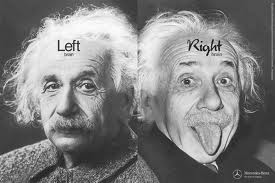
Last week, I spoke about the limbic system (or old brain) as being ‘downstairs’, and the pre-frontal cortex (or new brain) as being ‘upstairs’. Today, let’s look at the brain from a different perspective – left and right.

It has long been known that the left & right hemispheres of the human brain specialise in different areas of cognition, memory and reasoning. Put simplistically, the left side of the brain tends to be associated with more logical and analytical thinking, while the right hemisphere is linked to more creative pursuits and expressions of emotion, for example, through art and music.

source: hoffmanprocessuk.blogspot.com

Furthermore, Dr. Jordan Grafman, of the National Institutes of Health (NIH), puts forward evidence that the left-frontal lobe in a normal brain is specialized in storing of individual events, while the right-frontal lobe draws out themes and connections. People who have suffered damage or lesions to their right-frontal area often find it difficult to understand the point of a story, or a movie that they watch, and find the use of metaphor and simile extremely challenging. They understand the words spoken, and can make literal sense of things, but they lose the ability to interpret, extrapolate, find abstract meaning and so on.

But, from studying these unfortunate cases of people who have suffered brain damage, neuroscience has also discovered something fascinating about the way the hemispheres of the brain operate together. Some people who suffer damage or wastage in the left side of their brain, thereby losing their ability to understand the meaning of words, have been known to almost spontaneously develop unusual artistic and musical skills. In other words, skills that are typically processed in the right side of the brain. What is going on here?  Well, Dr. Bruce Miller, a neurology professor at UC, San Francisco, argues that the left hemisphere would normally Continue reading

The Upstairs & Downstairs Brain

Advances in neurosciences continue to inform our understanding of what makes us human, and perhaps even more importantly, how we interact with each other. In this week’s post I recommend two excellent speakers and experts in the field of neuroscience to you, Dan Siegel and Sarah-Jayne Blakemore.

We have passed through many periods of popular assumptions about the brain and the mind, including the tabula rasa (blank slate) theory that humans are born void of knowledge and acquire ideas and wisdom over time from the world in which they operate. And, until a few years ago, we believed that the wiring of our brains was pretty much determined and complete within the first few years of life. Advances in techniques for studying the brain, in recent years, have shown that development continues well into adolescence (and beyond), particularly in the pre-frontal cortex.  During this period of development an especially important process takes place. Synaptic pruning. Underused synapses and connections in the brain are pruned, just like weak or dead branches on a rose bush are cut away.  This is a vital phase of development of the brain, during which connections that are used are strengthened and those which are not are lost. Neurons that fire together wire together. (See also previous post on this subject: The “white stuff”, and what it means for your brain – March 2012) Continue reading