
Overcoming the Brain’s Negativity Bias

We didn’t get where we are today by being positive you know. Oh no.  Survival is a tough, uncompromising business.  Our ancient ancestors needed the negativity bias that is neurally wired into our brains in order to be successful. And successful they were; the fact you are reading this today being proof of that. The paradox is that this very successful survival mechanism – ‘the negativity bias’ – can often get in the way of people being able to experience life positively.

Let’s look at a simple model of how the human brain has been built up over tens of thousands of years of evolution.  (see also Rick Hanson’s article on this subject).          We can think of it as being composed of three (evolutionary) layers:

1. The Lizard Brain            This is the ‘old brain’. It shares many characteristics with the reptilian brain. It tends to fire in a reactive way. It is alert to dangers.  One classic and well-know example that is often quoted is the ’emotional hijack’ – when our emotions take over and we can actually feel like we are at the mercy of another brain. In some ways that is true.  When the ‘red mist’ falls across our eyes in moments of fury or fear, the lizard has taken over the controls.
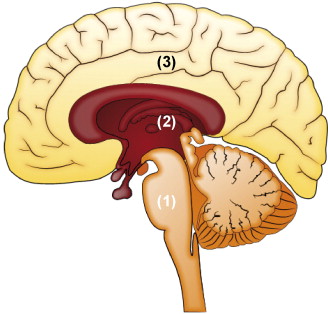
2.   The Mammalian Brain      The middle layer of the brain, which we share with other mammals (in an evolutionary sense) is much more concerned with seeking rewards. More sophisticated processing takes place at this layer than in the ‘old brain’, although in neuroplastic terms it is still relatively ‘rigid’.

3.  The Primate/Human Brain    The most recently developed, upper layer of the brains of primates and humans is concerned primarily with attachments and relationships.   We see this most clearly in the use of communication, language, social network development and extracted thought concerned with abstract concepts such as philosophy, religion and science.

Some of the most recent advances in the science of neuroplasticity have started to reveal amazing abilities for the brain to change and alter shape (by creating new connections and thickening existing connections) as a result of experiences and repeated use.  While neuroplasticity can, and does, take place at all three levels of the brain, it does appear that it is much more difficult to affect changes in the lizard brain than in the primate/human level (or neocortical region) of the brain.  For a superb in-depth treatment of this area, I refer you to Rick Hanson, author of Buddha’s Brain.

Why is this important?  Well, it means that, no matter how sophisticated and developed our thinking becomes, no matter how much we believe we have our emotions under control, there is, deep within our 21st Century selves, a part of us which is operating on one simple rule, which is basically “Get Lunch – Don’t Be Lunch!”

Now, even in the wild, most anxious episodes resolve fairly quickly.  The highly attuned Continue reading
Silencing the left brain

Last week’s post on the ‘Upstairs & Downstairs Brain’ attracted considerable attention, and elicited a number of responses – some favourable, some challenging. It appears that the implications of neuroplasticity are still very much at the early stage of consideration for many people, and, just how the new knowledge being generated can be put to use by coaches is not yet clear.

Last week, I spoke about the limbic system (or old brain) as being ‘downstairs’, and the pre-frontal cortex (or new brain) as being ‘upstairs’. Today, let’s look at the brain from a different perspective – left and right.

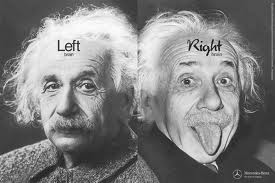
It has long been known that the left & right hemispheres of the human brain specialise in different areas of cognition, memory and reasoning. Put simplistically, the left side of the brain tends to be associated with more logical and analytical thinking, while the right hemisphere is linked to more creative pursuits and expressions of emotion, for example, through art and music.

source: hoffmanprocessuk.blogspot.com

Furthermore, Dr. Jordan Grafman, of the National Institutes of Health (NIH), puts forward evidence that the left-frontal lobe in a normal brain is specialized in storing of individual events, while the right-frontal lobe draws out themes and connections. People who have suffered damage or lesions to their right-frontal area often find it difficult to understand the point of a story, or a movie that they watch, and find the use of metaphor and simile extremely challenging. They understand the words spoken, and can make literal sense of things, but they lose the ability to interpret, extrapolate, find abstract meaning and so on.

But, from studying these unfortunate cases of people who have suffered brain damage, neuroscience has also discovered something fascinating about the way the hemispheres of the brain operate together. Some people who suffer damage or wastage in the left side of their brain, thereby losing their ability to understand the meaning of words, have been known to almost spontaneously develop unusual artistic and musical skills. In other words, skills that are typically processed in the right side of the brain. What is going on here?  Well, Dr. Bruce Miller, a neurology professor at UC, San Francisco, argues that the left hemisphere would normally Continue reading

The Upstairs & Downstairs Brain

Advances in neurosciences continue to inform our understanding of what makes us human, and perhaps even more importantly, how we interact with each other. In this week’s post I recommend two excellent speakers and experts in the field of neuroscience to you, Dan Siegel and Sarah-Jayne Blakemore.

We have passed through many periods of popular assumptions about the brain and the mind, including the tabula rasa (blank slate) theory that humans are born void of knowledge and acquire ideas and wisdom over time from the world in which they operate. And, until a few years ago, we believed that the wiring of our brains was pretty much determined and complete within the first few years of life. Advances in techniques for studying the brain, in recent years, have shown that development continues well into adolescence (and beyond), particularly in the pre-frontal cortex.  During this period of development an especially important process takes place. Synaptic pruning. Underused synapses and connections in the brain are pruned, just like weak or dead branches on a rose bush are cut away.  This is a vital phase of development of the brain, during which connections that are used are strengthened and those which are not are lost. Neurons that fire together wire together. (See also previous post on this subject: The “white stuff”, and what it means for your brain – March 2012) Continue reading

The “white stuff”, and what it means for your brain

I love this snow metaphor of how our ‘plastic’ brain works….(attributed to Pascual-Leone).

Neuroplasticity is like fresh pliable snow on a hill. When you go down the hill on a sled for the first time, you can be flexible in that you can choose whatever route to take. You can take different paths on your second and subsequent trips too if you like. However, if you choose to take the same path each time, a deeper and more permanent track will develop, and soon it will be difficult to sled down the hill without being ‘stuck in the rut’ you have created. Your route will now be quite rigid, and it will take some effort to break out of the rut and establish new pathways.

In a similar way, neural circuits, once established, tend to become self-sustaining. As Doidge puts it in his book “The Brain that Changes Itself”, neuroplasticity works both ways, it gives rise not only to mental flexibility and growth, but can also lead to mental rigidity and stagnation.    Continue reading

“Coaching is like Brain Surgery”. So, how sharp is your scalpel?

For a long time the received wisdom within the world of brain science has been about structure, fixed neural connections, localization of function and other related concepts. This view was largely influenced by some of the pioneering work of people like Hubel & Wiesel, Nobel Prize winners in 1981.

The idea that the brain may actually be ‘plastic’ in some way, that it may continue to make new connections, and that regions of the brain may actually be able to adapt and become responsible for function that it was not originally ‘mapped’ for, was dismissed until very recently.

The great news is Continue reading