Don’t let Goals dilute your Purpose

There are many words used to describe the things we do and the reasons we do them.  Objectives, targets, vision, dreams, goals, purpose, KPIs (ugh!), and I’m sure you can think of more.

Let me simplify this down to just two on this list.  Purpose and Goals.  Goals can play an important role in ensuring we stay focused. They provide us with milestones on a longer journey. They help us maintain momentum during periods when we might otherwise be distracted or lose some sight of our purpose. Goals on their own, without a bigger purpose, however, can cause us to drift aimlessly. It is important to periodically ask yourself the question “What purpose does achieving this goal serve?”

Too many leaders, managers, and teams of people in our corporations, find themselves participating in the annual game of concocting targets, objectives and goals, which then dominate meeting agendas, reviews and reports, often taking on a life of their own, and a level of importance that detracts from what ought be the real ‘purpose’ of the business.

Let me use an example from Continue reading

Don’t give me bad news

Nancy Kline in her superb book Time to Think describes a conversation with a senior civil servant whose department was going through wave after wave of changes to the way work was done and how things were structured. When asked how his managers were coping  with all of this, he responded, ‘I have no idea.  I don’t ask them.’  When asked ‘Why?’, he said, ‘They might tell me. We couldn’t have that.’  As Nancy goes on to explain, what he was really saying was thathe couldn’t handle that”.

How common is it for managers to shy away from facing up to the reality of what is going on around them, particularly when it might involve a face-to-face conversation with someone?  Very common, in my experience.   Confronting bad news, delivering home truths, providing feedback on performance, addressing inappropriate behaviour, or challenging resistance to change.  All of these scenarios present managers with situations which they either feel ill-equipped to handle effectively, or they ignore.

When managers fail to recognise an under-performing member of their team, there can be any number of underlying thinking errors or limiting beliefs at play.

For example:

  • They don’t want to admit they have someone under-performing as it may reflect badly on them
  • They don’t want to face the issue directly (it’s not in their nature), and they’re worried about handling any conflict that facing up to it might cause
  • The work is getting done to an ‘adequate enough’ level. Even though the individual is not adding as much as they potentially could, everyone’s reasonably happy – so why rock the boat?  (I dealt with this specific case in more detail in a previous post called Are you prepared to upset the Apple Cart?)
  • The individual is reasonably effective in some areas, so why not overlook or downplay issues in other areas where things could be better?
  • It is just a fact of life that some individuals are weak in certain skills or habits. We can’t change that.
  • The manager has been ‘friends’ with the individual and they’ve worked together a long time. They find it hard to confront them with hard messages.
  • The individual is a “nice” person, and it would hurt them to come down too hard on them
  • The individual is “slick” in that they always have a reason/response to issues raised with them, it’s just not worth the hassle of bringing up problems. After all, we’ve always managed to work round them in the past

Holding back, and not acting with complete honesty or sincerity does not create or encourage learning and improvement?  It does not prepare people for the future and help them adapt to change.

Fundamentally the approach to overcoming this type of ‘limiting thinking’ is simple….. Continue reading

When conflict works

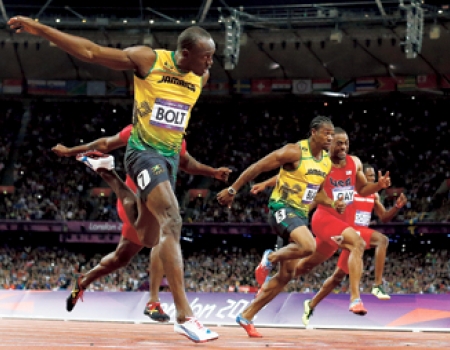
It seems to me, from reflecting on the Olympics, that truly great performances benefit from having someone else to ‘bounce off’. On occasions this can be achieved by colleagues in the same team pushing each other to ever higher levels, as evidenced by the Jamaican sprinters, Usain Bolt and Yohan Blake. It may also be achieved by fierce but respectful rivalry, where the standards of excellence set by one player forces the other to have to raise their game to heights they would not otherwise have to. The phenomenal standards of performance displayed by the world’s top tennis players is evidence of this. It is debatable whether Nadal would ever have reached the level of peak performance he has, if he was not asked some extraordinary questions on the tennis court by Federer. Djokovic has since had to take his game to even greater heights to become World number one. Whether friendly or fierce rivalry, in elite sport, the tensions, pressures, and challenges set, help motivate participants to keep raising their game.

But it is not only sport that can benefit from rivalry, conflict and challenge. Used effectively, disagreements and tensions can be hugely important in driving up standards in all walks of life.

This is illustrated most powerfully in this short clip of Margaret Heffernan, describing the inspiring story of Alice Stewart, an epidemiologist who struggled against the medical establishment to prove that x-rays on pregnant mothers were responsible for childhood cancers. During a long, and often lonely battle, to prove her case, Alice relied heavily upon a colleague, who was quite the opposite from Alice in many ways. His job, as a statistician and as a friend, was simple. To try to prove Alice’s data and results wrong. His job was to create conflict around her theories. Subjecting her work to this level of challenge and scrutiny, provided Alice with greater confidence about the validity of her theory, and helped her to find the energy to persist against formidable opposition.

So, how willing are we in the business world to be so open to this level of ‘voluntary’ challenge and conflict? To what extent are we willing to invite disagreement in the interest of true collaboration?  Continue reading

Breaking Barriers

As the London Olympic Games draw towards their close, it has been exciting to watch records tumble and barriers being broken. Of course, not all barriers are measured by distance or by the clock. Some of the most fascinating are psychological barriers.

Andy Murray appears to have broken a personal barrier in winning his Tennis singles gold medal. Regular readers will have read Learning from Wimbledon a few short weeks ago which described the progress Murray was making with his Inner Game. At the Olympics he buried the anguish he experienced a month ago, by defeating two of his fiercest opponents in quick succession, something he has found tough to do previously. He played unbelievably well, out-hitting, out-moving and out-thinking both Djokovic and Federer. A huge breakthrough, which may well see Murray move on to achieve much more success in future championships. .

Michael Phelps broke the barrier of all-time most decorated olympian – 22 medals – 18 of which are gold. This is a phenomenal achievement, even in a sport that provides more opportunity than most to multi-event. Phelps has set the bar at a new height for someone else to emulate in years to come.

Oscar Pistorius broke a barrier of a very different kind, becoming the first double amputee to ever take his place in an Olympics starting line up. He qualified from his heat to reach the semi-final of the 400m. A remarkable story which has cleared the way for future paralympians to stake their claim to be able to qualify for full olympic participation. New barriers will no doubt have to be overcome, but Pistorius has shown it is possible.

Some barriers are broken with increasing regularity, most notably in the swimming pool and in the velodrome, the latter no doubt assisted by advances in cycle technology. Others stand defiantly unobtainable, such as the long jump record which has stood for over 20 years. What fascinates me most of all is the psychological nature of breaking barriers.

Perhaps the best known example of this in the sporting arena is that of the mythical 4 min mile ‘barrier’. Until 1954, many actually believed that it was impossible, and perhaps even dangerous (or fatal) for anyone to run a mile faster than 4 mins. Roger Bannister became the first to make the breakthrough, and opened the floodgates for many others to do the same very soon afterwards. Soon the record was being broken over and over again. Those people who were soon running sub-4 minutes on a regular basis, were clearly physically capable of doing so, in the same way that Bannister did. The barrier they broke was inside their head, not on the track.

Running the 100m had a similar ‘magical’ barrier for quite some time. Once 10 sec was broken by Jim Hines in 1968, many others soon followed. The 100m final at this week’s Olympics was won by the extraordinary Usain Bolt. Had Asafa Powell not pulled up with an unfortunate injury, there is no doubt that every runner in the race would have gone under the 10sec barrier.

No-one has yet gone under 2 hours for the marathon, but it is getting closer with the current world record for men standing at 2hr 03min. It will be fascinating to observe how long it takes for the first person to run 1hr 59min 59sec, and how long afterwards we have to wait to see that time further reduced.

What is going on with these symbolic barriers, and what learning can it provide for other areas of life? In business, when people say it’s impossible, do they simply mean it’s not been done yet? Does it mean that Continue reading

Winning margins

Rebecca Adlington, the darling of British swimming, put in a faster time this week to win Olympic bronze in the 400m Freestyle than the time she clocked to win gold in the same event four years ago in Beijing.  This simple fact, whether surprising or not, encapsulates the essence of high performance sport. The margins between top performers are ever-decreasing, and every athlete is seeking that special something that might just give them the vital edge that will make the difference on the day.

People sometimes ask why people like Usain Bolt, Roger Federer or Tiger Woods need coaches. After all, when athletes have already become the best in the world, what more coaching do they need, and who is ‘qualified’ to coach someone who is the best?  The answer is simple. They want to remain the best, and only being as good as you are now is not going to achieve that.

I am fascinated by the variety of ways that performers seek to gain that vital edge over the competition. Swimmers, for example, are increasingly engaging in an intriguing mixture of cross-over training. Rock-climbing, pilates and ballet are just three unlikely activities that are being incorporated into their already punishing schedule. This is not just to generate variety and ease boredom from swimming lengths, although the value of that is not to be under-estimated, nor is it just because they are proven for building exceptional core strength, something that is vital for top swimmers. The additional benefits gained relate to developing an increased sense of overall body awareness. Having spatial awareness of hands and feet is very important to swimmers, especially in those micro-seconds and vital millimetres when a wall touch needs to be timed to perfection.  One swimming coach this week stated that “…..he and his swimmers will leave no stone unturned to find that extra ingredient that might just make the vital difference, and if that means tapping in to other disciplines then great”.

I referred in my last post to the importance of ‘Learning from the Outside’.  This can be thought of on different levels, whether as an individual or as an organisation. In any walk of life, whether athletics or business, any fresh and innovative ideas that can be drawn upon to enrich training methods, and ultimately produce peak performance are to be welcomed. Business leaders have been slower than their counterparts in the athletic world to adopt this ‘leave no stone unturned’ mindset, and to tap in to other disciplines to help create the winning edge. (See Why aren’t Business Leaders more like Athletes?)

Of course, this focus on sport and winning, raises another dilemma for many people. Some argue that competition can be harmful and unhealthy, and actually brings out the worst in people.  After all, not everyone can win the gold medal, and doesn’t competitive sport result in more disappointment and failure than anything else?  Well, I like the treatment this subject gets from Tim Gallwey in his book the Inner Game of Tennis.  “Winning is overcoming obstacles to reach a goal, but the value of winning is only as great as the value of the goal reached.”   In other words,  the essence of competition  is all about the challenge and obstacles to be overcome.  In a game of tennis, the opponent provides the obstacles required to allow a player to reach and experience their own peak performance.  To that end, when an opponent Continue reading