What’s your favourite Question?

“If I had an hour to solve a problem and my life depended on the solution, I would spend the first 55 minutes determining the proper question to ask, for once I know the proper question, I could solve the problem in less than five minutes.”  (Albert Einstein)

Have you ever thought about the power of questions?  We ask questions all the time but we probably don’t think much about doing it, or what impact our questions are having. There’s more to questions than simply choosing whether to use What, Where, Who, When, Which, How or Why?  Good questions are what drives creativity, discovery and progress.  But, I have a concern that our business culture and organisations do not encourage and reward behaviour that promotes good questions. Instead, our leaders and managers are expected to have ‘answers’ rather than questions and are expected to make decisions and fix problems.  This drives our management cultures toward adopting an ‘advocacy’ rather than an ‘enquiry’ philosophy, reinforcing the expectations of the workforce and of the leaders themselves.

More than ever, we need ‘new thinking’, fresh paradigms, and questions that challenge the ‘way things have always been done’.  Unfortunately, we don’t train people in the skill of constructing powerful questions, perhaps reinforced by the age-old ‘dogma’ that we pay people to come up with answers and solutions, not ask more questions.  Of course this is short-sighted thinking, and it is time to value the power of questions and to invest in the development of this most important of skills.

So, what makes a question ‘powerful’?  Here is a list proposed by Eric E. Vogt, Juanita Brown, and David Isaacs, 2003, in “The art of powerful questions”.

Powerful questions……

  • generate curiosity in the listener
  • stimulate reflective conversation
  • are thought-provoking
  • surface underlying assumptions
  •  invite creativity and new possibilities
  • generate energy and forward movement
  • channel attention and focus inquiry
  • stay with participants
  • touch a deep meaning
  • evokes more questions

A powerful question will also spread across networks of conversation, pervade organizations and communities, and are more often than not the catalyst for large-scale and transformational change.

Here are some examples of the types of questions that I believe have the power to shift thinking, tap in to people’s creativity, and open up possibilities that ‘more conventional’ ways of tackling issues may never discover. Continue reading

Are you a Lighthouse Leader?

I recall a seminar I attended a few years ago, where Chris Nichols (of Ashridge Consulting)  put forward the idea of thinking of leaders as lighthouses.  The concept has taken on new significance at this current time, as I observe businesses flounder, adrift in an ocean of unpredictability.  No business was ever created without a vision, aspirations, goals and dreams of succeeding.  Yet, the prevailing climate, the gloom of the global economy, and the rhetoric of politicians and media commentators, all combine to dampen spirits and encourage business leaders to keep their heads down till conditions change for the better. The trouble with this approach is that this will not help conditions change any time soon.

People tend to feed their emotions on what is around them, and if the only diet available is pessimism, negativity and aversion to risk, then that will, more than likely, become the prevailing culture.

We need leaders to be lighthouses. But, it is no good expecting to be able to navigate your course from a single beacon at the top of an organisation. To be able to steer one’s way successfully we need many lighthouses illuminating our way.  Many leaders, at all levels,  who act as beacons in a sea of darkness.  We need growing networks of lighthouses, whose beams combine to cast increasing clarity.

Those businesses that emerge from the current economic situation, in a stronger, leaner, and more vibrant state than others, are those that are Continue reading

From Conflict to Collaboration

Inter-personal or group conflict is an inevitable consequence of people working together in teams.  In fact, conflict can be a good thing, as it is a sign that people care and are passionate, and, if those energies are channelled correctly, they can be a great source of diverse ideas and solutions.

Too often however, conflict results in negative and damaging outcomes. It can hurt morale, suppress individual effectiveness, and, ultimately, destroy team productivity. Left untreated, it results in a downward spiral of negativity, emotions and blame.

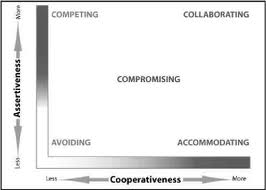
A helpful starting point is to understand some of the theory, and to recognise that people have different (and preferred) styles of dealing with conflict.  There is no one style that will work best in every situation, but once you have an understanding of the different styles, you have the opportunity to step back and think about the most appropriate approach (or perhaps mix of approaches) that will suit the current situation. And, having a raised awareness of your own ‘natural’ style is a good first step to helping you learn and adapt when necessary, so that it does not remain your only style.  (For a deeper treatment of this area, see the work of Ralph H. Kilmann and Kenneth W. Thomas)

The list of styles identified through their work are:

  • Avoiding - Acting in a  way that does not address the conflict directly. This style is typified by delegating controversial decisions, accepting default decisions, and not wanting to hurt anyone’s feelings. It can be a viable style to adopt when the issue and the relationship are of very low importance, but it should be used with extreme caution.  Avoiding a serious issue may make the conflict intensify, possibly damaging relationships further.
  • Accommodating – Involves accepting the other party’s position or interest at the expense of your own.  People who naturally adopt this style are not assertive but highly cooperative. It may be appropriate when the issue matters more to the other party and when peace is more valuable than winning. It can, however, be counter-productive as you may be seen as weak, especially if used repeatedly. Furthermore, constant ‘accommodating’ may lead to increased stress.
  • Competing – Working to have your position or interests take priority over those of the other party.  People who tend towards a competitive style take a firm stand, and know what they want, usually operating from a position of power (whether position, rank, expertise, or persuasive ability). It can be useful in an emergency when a decision needs to be made fast; or when defending against someone who is trying to exploit the situation selfishly. However it can leave people feeling bruised, unsatisfied and resentful when used in less urgent situations.  It is also not a useful style when it is important to generate diverse ideas or multiple solutions.
  • Compromising – Involves each party giving and getting a little in terms of position and interests.  People adopting a compromising style seek solutions that will to some extent  satisfy everyone. This approach depends on everyone being prepared to give up something. It can be useful when the cost of conflict is higher than the cost of losing ground, when equal strength opponents are at a standstill and when there is a deadline looming. It is unlikely to work successfully for issues of principle and may cut off opportunities for collaborative problem solving.
  • Collaborating – Parties attempt to meet all or most of the interests underlying their respective positions.  Collaborators can be highly assertive, but unlike the competitor, they cooperate effectively and acknowledge that everyone’s input is important. This is the most useful style when it is important to bring together a variety of viewpoints to get the best solution; when there have been previous conflicts in the group; or when the situation is too critical  for a simple trade-off.  It is most effective for generating ‘high-quality solutions’ but requires a very high level of trust between parties, and relies on the use of  considerable interpersonal skills (e.g. it is vital  to confront issues directly without threatening the other party). For some situations it may not be appropriate due to the fact that it can take considerable time and effort to implement.

‘True’ Collaboration is an often misunderstood and overused term.  It has been fashionable for companies to Continue reading

What gets in your way and blows the conversation?

Because we are human we have a number of fairly predictable reactions and behaviours in given situations.

All people, regardless of culture, gender, experience, job or position in the hierarchy, operate according to the same set of principles when under even fairly mild levels of stress. [For a more detailed treatment of this area I refer you to Chris Argyris' work on double-loop learning ] 

  1.  We seek to maximise comfort and minimise negative emotions - that means both our own and also the other person with whom we may be interacting at the time. 
  2. We will, at the same time as aiming to maintain a position of comfort, still aim to maximise our chances of winning and avoid losingin other words, we typically want to get our point across, and let others see where the problem lies or solution should come from
  3. And third, we seek to maintain controlwe typically try to put out a feeling of rationality and self-control (even when it is lacking) and aim to maintain control of where the discussion or outcome is going so that we can ‘steer’ others to the outcome we want

All of this adds up to a heady mix of potential problems in our everyday dealings with people – especially when stakes are raised, when emotions rise and when threats start to emerge.  The ways in which these principles and values emerge in our behaviour can differ from person to person – sometimes overtly and sometimes beneath a veneer of control, respectability and respect.  The underlying purpose of these strategies is to avoid vulnerability, avoid risk, and avoid appearing incompetent.

But, before you go away with an overly pessimistic view of the human race, don’t worry. First of all, this is natural, and is, to a large extent, a strategy that has helped us survive as a species through our evolution.  These strategies were necessary in the primeval world our ancestors navigated, but they are deeply defensive strategies, and rooted in a desire for self-preservation.  When they show up in our everyday lives, in meetings, in performance reviews and in relationships, they undermine our effectiveness and get in the way of building productive relationships, they are “anti-learning”, and damage the chances of constructive outcomes.

The good news is that we know about these de-railers and how and when they show up, and we can do something about it.

Fundamentally the approach to overcoming these is simple….. Continue reading